type

  • Feature Article
  • Podcast
  • Research

theme

  • Instant Activity
  • Food Literacy
  • Outdoor Learning
  • Physically Active Learning
  • Social Emotional Learning
  • Cross-Curricular Learning
  • Models-Based Approach
  • PHE Community
  • Healthy School Communities
  • Fundamental Movement Skills
  • Dance Education
  • Digital Literacy
  • Health Education
  • Financial Literacy
  • Physical Education
  • Sex Education
  • Educational Leadership
  • Equity, Diversity and Inclusion
  • Teacher Education
  • Mental Health
  • Substance Use
  • Truth & Reconciliation

Search Results

SORT BY:

The PHE Canada Podcast, Season 1 - Episode 5: What We Know (and Don't Know) About Vaping
May 17, 2024
The PHE Canada Podcast, Episode 5: What We Know (and Don't Know) About Vaping

Did you know that about 15% of high school students have been vaping in the last month and around 35% of youth between the ages of 15 to 19 in Canada have vaped?

Welcome to The PHE Canada Podcast! In the fifth episode of our podcast, we speak with Dr. Tea Rosic, Child & Adolescent Psychiatrist at the Children’s Hospital of Eastern Ontario (CHEO) and Clinician-Investigator at the CHEO Research Institute and the University of Ottawa, and Ryan Fahey, Lead, Programs & Resources at PHE Canada, who works closely with school communities taking a comprehensive school health approach to address commercial tobacco use and vaping in their schools through the Students Together Moving to Prevent Tobacco Use (STOMP) program. Alongside our host, Josh Read, our guests open a dialogue around the issues we are seeing across the country - as early as elementary school. Dr. Rosic and Ryan share their unique perspectives and insights on navigating the complexities around vaping and nicotine amongst youth such as:

  • How withdrawals can impact the school day;
  • Challenges educators are facing;
  • Strategies educators and schools can use when supporting students;
  • Tools to address vaping in your school;
  • Youth vaping statistics and prevalence in Canada, and much more!

Check out the following resources discussed in the episode:

                Listen on YouTube


Additional Canadian Vaping Statistics: 

  • As of 2020, 5.2 million Canadians aged 15 and 19 had vaped and more than 1 in 3 of high school aged youth vaped within 30 days of reporting. (CTNS, 2020) 
  • 1/3 of youth aged 15-19 who vape cited their main reason for vaping in the past 30 days was to reduce stress. (CTNS, 2021) 
  • Among youth aged 15 to 19 who used a vape, most (55%) reported buying their devices from a friend or family member, asking someone else to buy them for you, and having a friend or family member give or lend them to you. (CTNS, 2020) 
  • The prevalence of trying vaping at least once among youth aged 15 to 19 was 35% (711,000). (CTNS, 2020) 
  • Among Canadians aged 15 years and older who used a vape in the past 30 days, 83.1% [95% CI: 78.6, 87.5] (1.3 million) reported vaping an e-liquid containing nicotine. (CTNS, 2021)    


Recent Posts

An abstract line drawing showing two profiles of heads with pink brains inside. The heads are facing in opposite directions, one left and one right. The background shows a colourful ripple effect.
How I Tried to Gamify Physical Education
[ Feature Article ] After leaving teaching in 2017, I took on several long-term occasional (LTO) placements. More often than not, I was assigned a timetable that had several Grade 9 classes. During my years as a teacher...
Authored by: Rob Pacas
A group of kids enjoying the food in schools.
Rethink Food Literacy Education with BrightBites
[ Feature Article ] Ontario Dietitians in Public Health (ODPH) introduces BrightBites, a bilingual digital platform designed to support educators and school staff in fostering food literacy and body inclusivity within school settings. Anchored by three evidence-based Guiding Principles—positive food discourse, respect for food-related roles, and promotion of body diversity—BrightBites encourages a shift away from traditional “healthy vs. unhealthy” narratives. Through practical actions, curriculum-linked resources, and supportive guidance, the website empowers adults in schools to cultivate environments where students can build positive relationships with food and feel accepted in their bodies.
Authored by: Chantal de Laplante
two students playing with balance board in a school gym.
The Rise of Circus Arts in Physical Education: A Fun, Engaging Way to Enhance Physical Literacy and Physical Activity Experiences
[ Feature Article ] Circus arts instruction delivered in primary physical education can have many benefits to the holistic development of children in the physical, social, psychological, and creative domains. This includes meeting curricular expectations and fulfilling many characteristics of quality physical education, including the development of physical literacy. This article addresses some of the benefits, as well as the issues to address for implementation in your school.
Authored by: JJ Ross, Bryan Vermeylen
A group of children are sitting in a circle with a teacher and talking heart-to-heart.
You Belong Here: Five Strategies for Inclusive Physical and Health Education
[ Feature Article ] This article presents five practical strategies to create inclusive physical and health education (PHE) spaces. Grounded in two of five Equity By Design principles and culturally responsive practice, this article invites educators to reflect on who their PHE spaces are designed for and how small shifts can help students thrive and transform PHE spaces into areas where every student feels seen, valued, and empowered to participate fully.
Authored by: Jacinta Williams
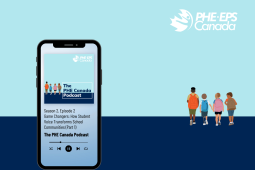
The PHE Canada Podcast, Season 2 Episode 1
The PHE Canada Podcast, Season 2 - Episode 1: Supporting Teacher Well-Being at the University of Lethbridge
[ Podcast ] In the first episode of the second season of the PHE Canada Podcast, host Caleb Poulin sits down with Aaron Stout, Greg Ogilvie, and Dawn Burleigh from the University of Lethbridge to explore how wellness is being woven into the fabric of their teacher education program.
Authored by: Aaron Stout, Greg Ogilvie, Dawn Burleigh
A joyful group of children and adults celebrating their victory after a basketball game, smiling and cheering together.
Reconceptualizing Physical Education to Enhance Student Motivation: Overcoming Teacher, Institutional, & Student Barriers
[ Research ] Abstract The health and well-being of young people continues to be a growing concern for parents and educators across the country. Sedentary behavior and mental health issues are rising steadily in...
Authored by: Dr. David Chorney, Karly Scott