Stronger Together: Connecting Subjects to Ignite Student Learning

Preamble
Over the past 25 years, since the time I began my teaching career during the 1999-2000 school year, I have found myself discussing, discovering, and implementing ways to connect curricular areas together to support student learning. As part of my formal teacher education program, I was fortunate to closely observe my cooperating teachers seamlessly connect subjects together (e.g., Science & Art, Physical Education & Social Studies, English Language Arts & Music). During my formal teacher practicums—back in the late-1990s—questions that my cooperating teachers often raised included: “Do we tell students to stop thinking about Math, now that we’re beginning a Science lesson?” and “Should students stop thinking about the impact of Music while writing a story during an English Language Arts lesson?” The answer to both these questions is a resounding “No!” And that focus pertaining to effective teaching has stayed with me for 25+ years … whether it be in the school classroom, gymnasium, outdoor learning environment, etc., or at the post-secondary level teaching ‘teacher education’ and graduate programs (e.g., MEd students). The concept behind ‘cross-curricular connections’ has remained a constant in my planning, teaching, and assessment (see Kruse et al., 2021). And now, by writing this blog, I hope to share a few ideas pertaining to cross-curricular connections that may help add to the body of knowledge for teacher consideration, implementation, and evaluation in their learning environments.
Cross-Curricular Connections: A Brief Introduction
In the simplest explanation, cross-curricular connections refer to the fusing of two or more subjects during a lesson where specific knowledge and skills are taught (and learned) in each of the connecting subjects, affording students with rich learning experiences helping them make connections across subjects and bringing the learning to life (Ontario, 2025). As cross-curricular connections can effectively foster learning, while nurturing student motivation, creativity, and discovery through learning opportunities to cultivate thinking and reasoning skills, benefits include: building on prior knowledge; unifying student learning; reflecting real world situations; and matching student thinking processes (Alberta Education, 2007, Bradford & Schmidt, 2016; Ontario, 2025).
While helping students develop a more thorough understanding of key curricular learning outcomes, when planning for cross-curricular connections, it is essential for teachers to recognize the importance of meeting intended learning outcomes in each subject; one subject (e.g., Science) receiving a large portion of the lesson’s focus, while another subject receiving a minimal amount of focus does not equate to truly being a cross-curricular connection (Gleddie et al., 2018).
Cross-Curricular Connections: Examples
With an innumerable amount of possible cross-curriculum connections that teachers can use in their K-6 teaching, for this blog, I expand upon an example discussed in Canadian Teacher Magazine (see Bradford & Schmidt, 2016). Of course, each teacher will read this example differently and visualize how they can employ the overarching ideas within their own planning when considering their own grade level and learner needs.
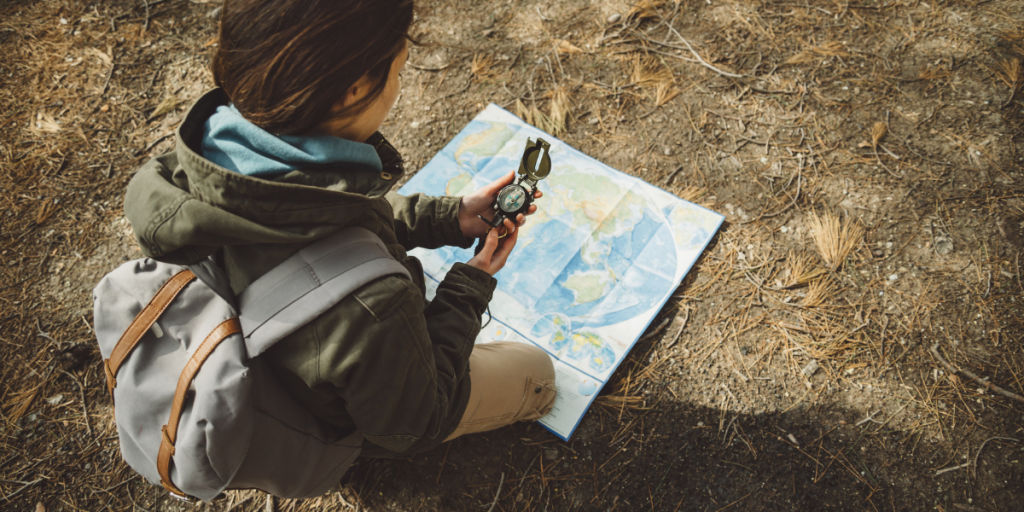
Example 1: Connecting Physical Education & Science (K-6 Students)
“Students, today we are going Science Orienteering! Now, let’s go outside and learn!”
- Pond Studies & Orienteering: Studying ponds, in the natural environment, can prove to be a seamless way for teaching Science learning outcomes while helping students enhance their first-hand knowledge about natural phenomenon. Within this nature-inspired learning activity, curricular outcomes from Physical Education related to the dimension of Alternative Environment Activities (Gleddie et al., 2018; Hall et al., 2022) can connect easily. For example, students can engage in an Orienteering-type activity as they are tasked with problem-solving, exploration, and discovery while locating specific Science phenomena to be examined. As part of the Orienteering portion of the lesson, students can be provided opportunities to work in partners, engage in challenging physical activity (e.g., travelling to various locations using different forms of locomotor skills, such as skipping, running, hopping, climbing), and solve questions related to Science (and Physical Education) at each Control Point (for example, see Hall et al., 2015).
- Possible Control Point Questions (Recommendation: 5-6 Control Points)
- Control Point 1. Write a brief description of the surroundings (e.g., pond, flowers, insects).
- Control Point 2. With your partner, grab 2-3 bean bags and toss them back and forth for a total of 25 tosses and catches.
- Control Point 3. Identify three items that are listed in the ‘Science Passport’ (e.g., type of flower, type of insect, pond-related item).
- Note 1: For this lesson, teachers can be highly creative fusing both their grade level’s Science and Physical Education curricula to ensure a cross-curricular connection is taking place through what can be termed: Science Orienteering!
- Note 2: For younger learners (e.g., K-2), String Orienteering is an effective modification to the Orienteering part of this lesson (see Bradford & Hall, 2025).
- With Science Orienteering, addressing multiple learning outcomes across the two connecting subjects, K-6 students will become more aware of how their learning is meeting curricular outcomes in both Science and Physical Education; cross-curricular learning helps meet a range of meaningful benefits for student development (e.g., problem-solving, exploration, discovery, cooperation).
- Supporting Resources: For additional information pertaining to the Sport of Orienteering, Table 1 lists a few organizations for teachers to check out.
|
Table 1. A Few Orienteering Organizations |
|
|
Alberta Orienteering Association |
|
|
Orienteering Canada |
|
|
International Orienteering Federation |
|
|
Orienteering Ontario |
|
Example 2: Physical Education & Language Arts (Grade 7-12 Students)
“Students, today we are going to be Sports Reporters! Let’s get reporting!”
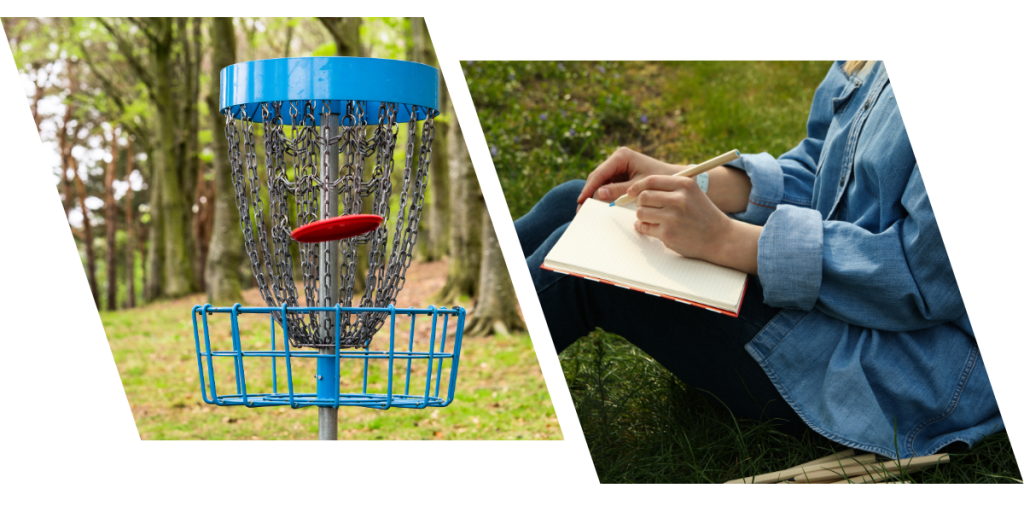
- Disc Golf & Journalistic Writing. When teachers are looking for meaningful ways to connect an Alternative Environment Activity (Physical Education) and creative writing, fusing a Disc Golf game with journalistic writing can help meet that criteria; in such a lesson, students can develop their skills in both Physical Education and Language Arts. In Table 2, a step-by-step description is outlined for teachers to consider, adapt, modify, and expand upon to help meet their students’ learning needs and, of course, grade level curricula.
|
Table 2. Disc Golf & Journalistic Writing |
||
|
Step # |
Learning Task & Description |
Subject Learning Skills |
|
Step 1 |
Play a 9-Hole Disc Golf Game |
Physical Education Learning
Language Arts Learning
|
|
Head out to a local Disc Golf course (or set up a modified course in your schoolyard or local park area). In groups of four, students will:
Students should be encouraged to observe their game action closely—not just as players (themselves), but as sports reporters ‘gathering the scoop’ for a report (e.g., article, vlog). |
||
|
Step 2 |
Write a Sports Report on the Disc Golf Game |
Language Arts Learning
Physical Education Learning
|
|
After returning back to the classroom, students will channel their ‘inner writer’ by compiling/writing a sports report on their Disc Golf game. For example, from their own perspective, each student will be asked to write a 500-word report covering the game action that they were part of bringing together their observations, notes, and from what they discuss with their teammates and opponents throughout the game action. To promote student choice, however, the ‘Sports Reporters’ can compile/write their report in one of the following formats:
|
||
|
Step 3 |
Conduct a Class-Wide (or School-Wide) ‘Sports Report’ Showcase |
|
|
|
As the culminating activity for this cross-curricular connection, the class can share their ‘Sports Reports’ as part of a class-wide (or school-wide) ‘Sports Report Showcase’. To promote student choice, students can choose one of the following ways to share their ‘Sports Reports’ in the class-wide (or school-wide) showcase:
|
|
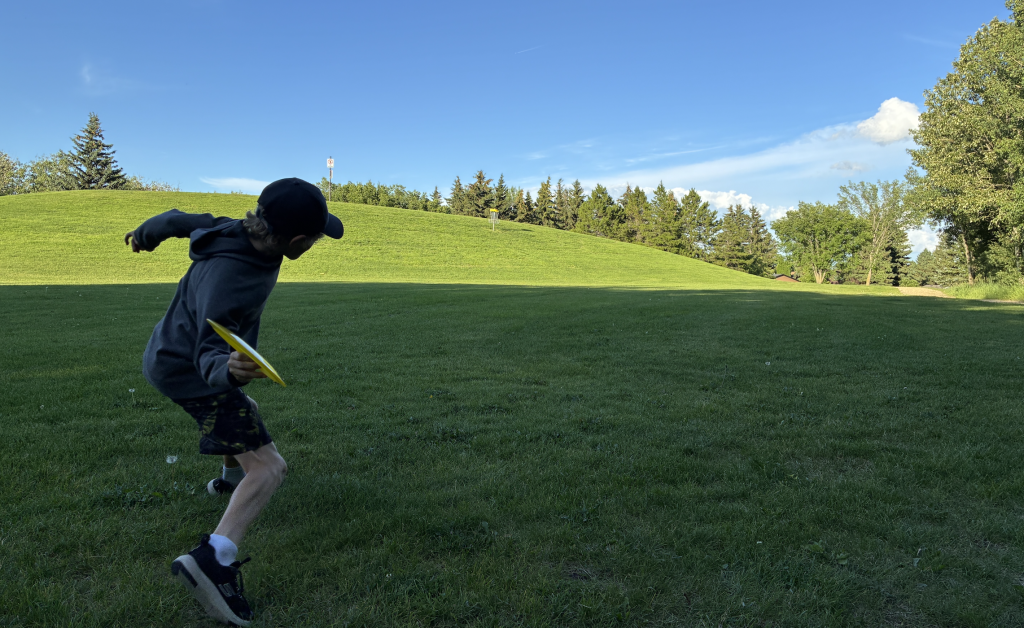
- Note 1. For this lesson, students can view themselves as both ‘Disc Golf Athletes’ and ‘Sports Reporters’. While meeting curricular learning outcomes in both Physical Education and Language Arts, this cross-curricular connection leads to elevated levels of meaningful learning opportunities, cooperation, personal (and team) goal-setting, and engagement in an Alternative Environment Activity that leads to countless student benefits, including experiencing the pure joy of movement.
- Note 2: For higher grade levels (e.g., Grade 10-12), students could organize a Disc Golf Tournament and connect the entire tournament (e.g., format, scheduling, results, standout moments) into the ‘Sports Report’ part of the lesson.
- Teaching Considerations. To help students reach a high level of success with this cross-curricular connection, a few teaching considerations include the following:
- Have the groups of 4 begin at different ‘Tee Off/Throw Off’ locations along the Disc Golf course (promoting a staggered start) to allow for groups to spread out; not bunch up
- Show and discuss a few real examples of ‘Sports Reports’ (e.g., articles, blogs, videos)
- Provide choice; consider diverse learning needs
- Encourage innovation, creativity, and inclusion of other subjects (e.g., semi-structured interviews, statistical analyses, sketches, photography, videography)
- Provide time for collaboration with peers to discuss their thoughts, ideas, strategies, etc.
-
Supporting Resources: For additional information pertaining to the Sport of Disc Golf, Table 3 lists a few organizations for teachers to check out.
|
Table 3. A Few Disc Golf Organizations |
|
|
Bay St. George Disc Golf Association |
|
|
Disc Golf Newfoundland & Labrador |
|
|
Edmonton Disc Golf Association |
|
|
Professional Disc Golf Association |
|
Concluding Thoughts
Teachers, I hope this blog has provided some ‘food for thought’ as you continue planning, teaching, and evaluating your quality Physical Education programs, and as you continue searching for ways to connect Physical Education-related learning outcomes to other subjects—providing opportunities to apply new knowledge and skills in meaningful contexts across subjects (Ontario, 2025)—to enhance student learning. To help support the notion of cross-curricular connections, as discussed throughout this blog, Table 4 describes ‘Three To-Dos’ that I would like to raise for further discussion with educational stakeholders.
|
Table 4. Three To-Dos |
|
|
Elementary School Teachers |
Search for ways to connect the curriculum (subject to subject) through networking with teaching colleagues; most likely there is a teacher (in your school or broader professional network) that has a great depth of awareness and passion—and perhaps a high level of education—in another subject other than Physical Education (e.g., Science, Social Studies); take time to plan with your colleagues to discover ways to connect subjects. |
|
PHE Canada & Other PHE-related Organizations |
Provide opportunities for teachers to learn more about cross-curricular connections (e.g., conference presentations, teacher workshops, blogs, podcasts) in order to recognize and understand the numerousbenefits of such connections for profound, meaningful student learning. |
|
Teacher Education Programs |
Discuss, discover, and implement ways for subject-specific pre-service teacher education course professors/instructors (e.g., Social Studies, Physical Education and Wellness) to collaborate on cross-curricular connection lessons, class discussions, student assignments, etc. illuminating realistic—and meaningful—ways for teachers to help students ‘connect the dots’ while fully recognizing and acknowledging connections between subjects. |
Cross-curricular connections do not have to be complicated; alongside a dose of discussion, teamwork, and creativity, teachers can help students experience that physical literacy development, for instance, can be connected seamlessly to other subjects for authentic learning. As educators, when we connect subjects and ignite curiosity, inquiry, and wonder throughout the curriculum, we cultivate transformative learning and inspire lifelong exploration and discovery that empowers every student to shine brighter—truly, subjects are stronger together.
A final question for teacher consideration: Which learning outcomes, from different subjects, can be connected—seamlessly? I suggest starting there!
Enjoy your cross-curricular connections!
Reference
Alberta Education. (2007). Primary programs framework for teaching and learning – Curriculum integration. Alberta Education. https://education.alberta.ca/media/563581/guidingprinc_curr2007.pdf
Bradford, B. & Hall, N. (2025). Stringing together: An alternative environment activity. Canadian Teacher Magazine. (Spring 2025), 28-29. https://canadianteachermagazine.com/2025/04/20/12875/
Bradford, B. & Schmidt, E. (2016). Making cross-curricular connections. Canadian Teacher Magazine. (April/May 2016), 16-17. https://canadianteachermagazine.com/2016/04/17/making-cross-curricular-connections/
Gleddie, D., Hickson, C., & Bradford, B. (2018). Physical Education for Elementary School Teachers: Foundations of a Physical Literacy Journey. Ripon Publishing: Victoria, BC.
Hall, N., Bradford, B., & Hickson, C. (2015). Orienteering: A fun way to get physically active in an outdoor environment. Runner - Journal of the Health and Physical Education Council (HPEC) of the Alberta Teachers’ Association, 47(1), 9-12.
Hall, N., Robinson, D., Bradford, B, & da Costa, J. (2022). Alternative environment activities in physical education: A research-informed rationale and practical suggestions for teacher practice. Journal of Physical Education, Recreation & Dance, 93(1), 36-44. doi:10.1080/07303084.2021.2000526
Kruse, J., Bradford, B., Liddell, B, & Camarta, B. (2021). Math trails: New adventures are waiting! Canadian Teacher Magazine. (Spring 2021), 22-24. https://canadianteachermagazine.com/2021/04/21/10498/#more-10498
Ontario. (2025). Curriculum and Resources: Cross-curricular and Integrated Learning. https://www.dcp.edu.gov.on.ca/en/program-planning/cross-curricular-and-integrated-learning/integrated-learning
Authors