type

  • Feature Article
  • Podcast
  • Research

theme

  • Instant Activity
  • Food Literacy
  • Outdoor Learning
  • Physically Active Learning
  • Social Emotional Learning
  • Cross-Curricular Learning
  • Models-Based Approach
  • PHE Community
  • Healthy School Communities
  • Fundamental Movement Skills
  • Dance Education
  • Digital Literacy
  • Health Education
  • Financial Literacy
  • Physical Education
  • Sex Education
  • Educational Leadership
  • Equity, Diversity and Inclusion
  • Teacher Education
  • Mental Health
  • Substance Use
  • Truth & Reconciliation

Search Results

SORT BY:

Activating Schools as a Key Driver in Federal Sport Policy - A PHE Canada Advocacy Report

August 28, 2025
A group of children joyfully playing soccer in a sunny park, with trees and grass in the background.

This advocacy report, prepared for the Future of Sport in Canada Commission, positions schools as a critical driver in shaping the future of Canada’s sport policy. It argues that school-based physical education and sport must be recognized not just as supplementary activities, but as foundational to participation, equity, development, and long-term excellence in Canadian sport.

2025 PHE Canada Advocacy Report for the Future of Sport in Canada Commission
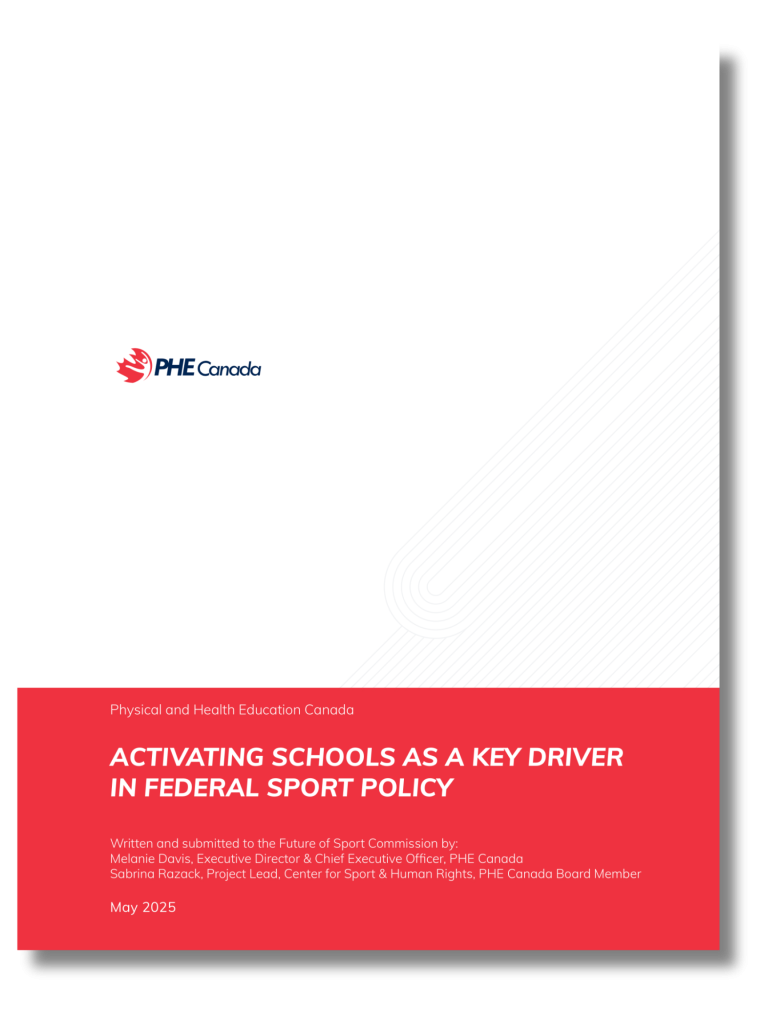
This image represent the front page of PHE Canada's advocacy report to the Future of Sport Comission

Read the 2025 PHE Canada Advocacy Report

The Future of Sport in Canada Commission interim report dropped today, and the opening words are a heavy truth -"the Canadian sport world is in crisis... it is broken.”

Melanie Davis, Executive Director & Chief Executive Officer of PHE Canada

The Future of Sport in Canada Commission offers Canada a unique opportunity to reimagine its sport system by embedding schools at the heart of federal policy. While much of the national conversation has centered on high-performance sport, governance, and funding, this report underscores that schools are the most equitable and accessible entry point to organized sport for children and youth, particularly those in underserved, rural, or marginalized communities.

PHE Canada asserts that schools provide more than athletic development—they foster physical literacy, confidence, leadership, teamwork, and lifelong habits of movement. Yet, current school sport systems face deep inequities, underfunding, and fragmented governance, leaving many students without safe, inclusive, and consistent opportunities.

Drawing on a nationwide dialogue of educators, students, Indigenous knowledge holders, academics, and community partners, the submission identifies four federal leadership opportunities:

  1. Targeted Funding through Intermediaries to address disparities in infrastructure, equipment, and program access.
  2. Centralized Governance and School Sport Policies to ensure consistent standards, alignment with Safe Sport principles, and equitable participation across jurisdictions.
  3. A Coordinated Federal Strategy—including a Federal School Sport and Physical Activity Framework—to unite education and sport systems and close access gaps.
  4. Enhanced Teacher Preparation and Recognition to equip educators as skilled leaders in safe, inclusive sport and to sustain their vital role as teacher-coaches.

The report concludes with three urgent recommendations:

  1. Develop a coordinated federal strategy for school sport and physical activity.
  2. Invest directly in schools and intermediaries to expand inclusive, high-quality opportunities.
  3. Modernize the Physical Activity and Sport Act to fully integrate education as a pillar of Canada’s sport system.

By prioritizing schools, Canada can expand equitable access, strengthen community well-being, and ensure that sport is not just a privilege for the few, but a shared foundation for every student.

Recent Posts

A group of children are sitting in a circle with a teacher and talking heart-to-heart.
You Belong Here: Five Strategies for Inclusive Physical and Health Education
[ Feature Article ] This article presents five practical strategies to create inclusive physical and health education (PHE) spaces. Grounded in two of five Equity By Design principles and culturally responsive practice, this article invites educators to reflect on who their PHE spaces are designed for and how small shifts can help students thrive and transform PHE spaces into areas where every student feels seen, valued, and empowered to participate fully.
Authored by: Jacinta Williams
The PHE Canada Podcast, Season 2 Episode 1
The PHE Canada Podcast, Season 2 - Episode 1: Supporting Teacher Well-Being at the University of Lethbridge
[ Podcast ] In the first episode of the second season of the PHE Canada Podcast, host Caleb Poulin sits down with Aaron Stout, Greg Ogilvie, and Dawn Burleigh from the University of Lethbridge to explore how wellness is being woven into the fabric of their teacher education program.
Authored by: Aaron Stout, Greg Ogilvie, Dawn Burleigh
A joyful group of children and adults celebrating their victory after a basketball game, smiling and cheering together.
Reconceptualizing Physical Education to Enhance Student Motivation: Overcoming Teacher, Institutional, & Student Barriers
[ Research ] Abstract The health and well-being of young people continues to be a growing concern for parents and educators across the country. Sedentary behavior and mental health issues are rising steadily in...
Authored by: Dr. David Chorney, Karly Scott
Two youth moving on running track.
Problematizing and Rethinking Elementary Track and Field School Days: Re-envisioning a Future for All
[ Research ] Abstract Elementary track and field days can be an enjoyable way of participating in physical activity outdoors. Unfortunately, these events are not always a positive experience for all students, and...
Authored by: Alexandra Stoddart, Sara Schroeter
A person swimming in a clear blue pool, creating ripples in the water.
Swim X: Bridging the Water Safety Gap for Newcomer Youth in Canada
[ Feature Article ] Swim X is a youth-led swim program developed to address a critical gap in water safety education among newcomer children in Canada. While 80% of Canadian-born individuals report some swimming ability...
Authored by: Xander Christian
A group of children in a school holding colorful signs, smiling and engaging with their surroundings.
Social Return on Investment (SROI) Analysis of the Students Together Moving to Prevent Tobacco Use (STOMP) Program
[ Feature Article ] The Students Together Moving to Prevent Tobacco Use (STOMP) program, led by PHE Canada and funded by the Public Health Agency of Canada, was implemented as a multi-year pilot from 2021 to 2024. This...
Authored by: PHE Canada