type

  • Feature Article
  • Podcast
  • Research

theme

  • Instant Activity
  • Food Literacy
  • Outdoor Learning
  • Physically Active Learning
  • Social Emotional Learning
  • Cross-Curricular Learning
  • Models-Based Approach
  • PHE Community
  • Healthy School Communities
  • Fundamental Movement Skills
  • Dance Education
  • Digital Literacy
  • Health Education
  • Financial Literacy
  • Physical Education
  • Sex Education
  • Educational Leadership
  • Equity, Diversity and Inclusion
  • Teacher Education
  • Mental Health
  • Substance Use
  • Truth & Reconciliation

Search Results

SORT BY:

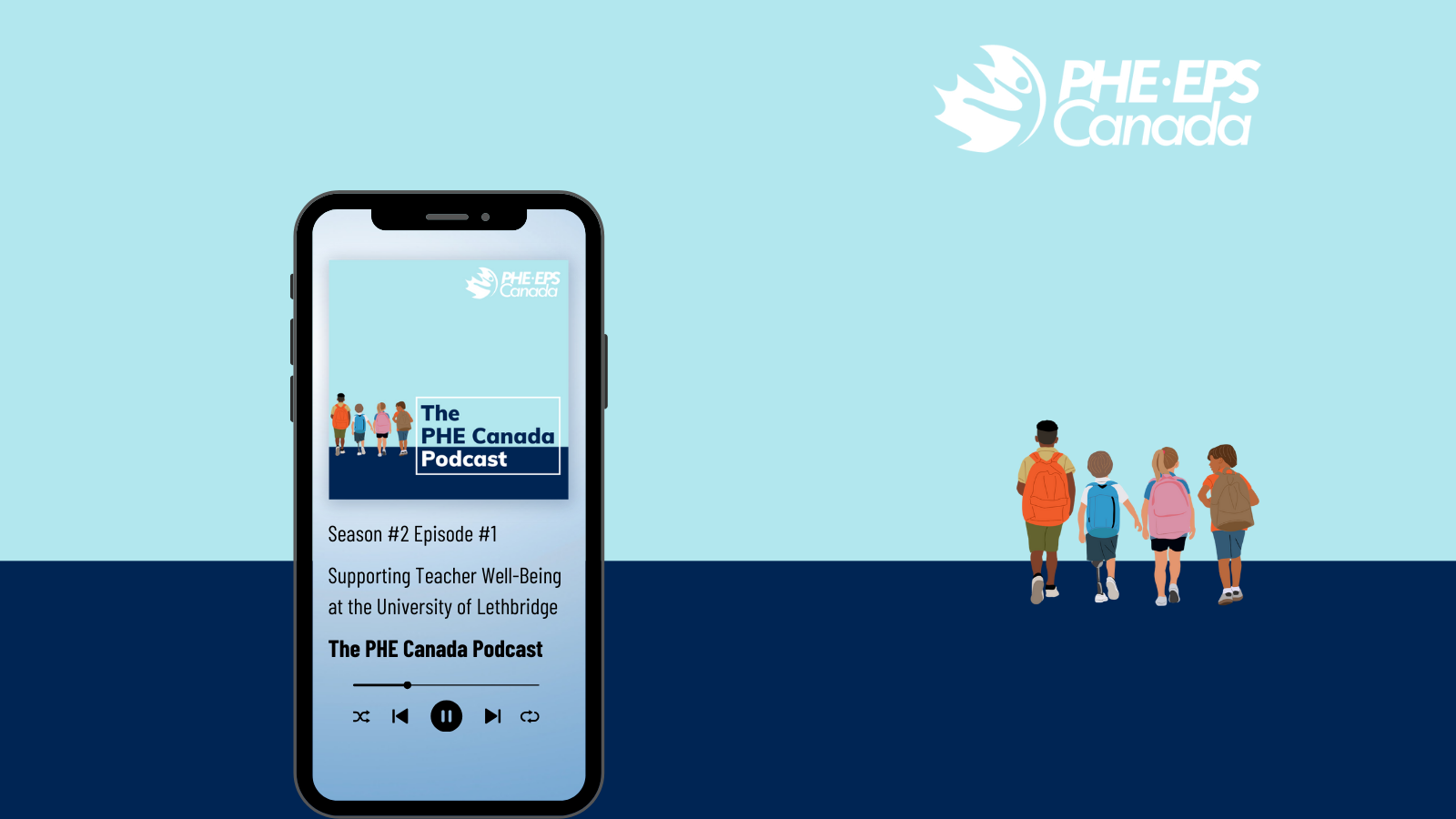
The PHE Canada Podcast, Season 2 - Episode 1: Supporting Teacher Well-Being at the University of Lethbridge
December 17, 2025
The PHE Canada Podcast, Season 2 Episode 1

Welcome to the PHE Canada Podcast! In the first episode of our second season, host Caleb Poulin sits down with Aaron Stout, Greg Ogilvie, and Dawn Burleigh from the University of Lethbridge to explore how wellness is being intentionally woven into the fabric of teacher education.

Together, they share the story of the University of Lethbridge’s Wellness Committee—how it began, how it has evolved, and why they firmly believe that “well spaces are learning spaces.” This thoughtful conversation unpacks how prioritizing wellness can support both personal wellbeing and professional sustainability for educators.

Throughout the episode, our guests reflect on the importance of addressing burnout and attrition in the profession, while empowering pre-service teachers to see wellness not as an add-on, but as a foundational element of effective teaching. Drawing on real examples and lived experience, they highlight how a culture of wellness can positively shape learning environments and educator identity.

This episode dives into conversations around:

  • How the University of Lethbridge is embedding wellness into its Bachelor of Education program;

  • The power of student-led initiatives and community-driven approaches to wellbeing;

  • Practical ways educators can model wellness, build supportive learning spaces, and sustain their energy over the long term; and

As Caleb reminds us, wellness is a culture. When educators experience it themselves, they are better equipped to pass it on to their students.

A special thank you to Aaron, Greg, and Dawn for sharing their insights and passion for creating healthier, more connected learning spaces.


Recent Posts

Two colorful puzzle pieces with a mosaic pattern of different shapes and colors on a light wooden background.
Stronger Together: Connecting Subjects to Ignite Student Learning
[ Feature Article ] In schools, across all grade levels, cross-curricular connections result in countless benefits for student learning. Cross-curricular connections are purposefully planned lessons that fuse two or more subjects, providing students with meaningful learning experiences while ‘connecting the dots’ between subjects. In this blog, I share a brief introduction and a few teaching considerations pertaining to cross-curricular connections, along with two examples—one for K-6 and one for Grade 7 and above. Alongside some supporting materials, I conclude with a list of ‘Three To-Dos’ for educational stakeholders to consider when thinking about the innumerable amount of benefits that can arise from cross-curricular connections in the learning environment.
Authored by: Brent Bradford
A solitary tree stands in a vast grassy field, silhouetted against a dramatic sunset sky with scattered clouds and rays of light breaking through.
Animality, Technology & Connecting to the Natural World: A Posthuman Approach to Physical Education
[ Research ] This paper explores a posthumanist approach to physical education (PE) to address declining well-being in both human and non-human worlds. It acknowledges the challenges of operating within a humanistic framework that often prioritizes human-centric goals and colonial perspectives. The proposed vision emphasizes reconnecting with our animality through self-directed and rough-and-tumble play, fostering creativity, social bonds, and a recognition of human-animal similarities.
Authored by: Ty Riddick
A group of kids are standing against a white wall, smiling and holding colorful balls ready to throw.
Pins and Bottles: Fun, Budget-Friendly Ideas for Target Games!
[ Feature Article ] Bowling pins, thin pins, and numbered pins are fantastic tools for target games—but you do not need anything fancy to get started. Empty water or soda bottles make a fun, budget-friendly alternative. Throughout this post, I will refer to them all as “pins,” but remember that bottles work just as well. For added flair and scoring variety, try filling bottles with water and a splash of food coloring.
Authored by: Dr. John Byl
An abstract line drawing showing two profiles of heads with pink brains inside. The heads are facing in opposite directions, one left and one right. The background shows a colourful ripple effect.
How I Tried to Gamify Physical Education
[ Feature Article ] After leaving teaching in 2017, I took on several long-term occasional (LTO) placements. More often than not, I was assigned a timetable that had several Grade 9 classes. During my years as a teacher...
Authored by: Rob Pacas
A group of kids enjoying the food in schools.
Rethink Food Literacy Education with BrightBites
[ Feature Article ] Ontario Dietitians in Public Health (ODPH) introduces BrightBites, a bilingual digital platform designed to support educators and school staff in fostering food literacy and body inclusivity within school settings. Anchored by three evidence-based Guiding Principles—positive food discourse, respect for food-related roles, and promotion of body diversity—BrightBites encourages a shift away from traditional “healthy vs. unhealthy” narratives. Through practical actions, curriculum-linked resources, and supportive guidance, the website empowers adults in schools to cultivate environments where students can build positive relationships with food and feel accepted in their bodies.
Authored by: Chantal de Laplante
two students playing with balance board in a school gym.
The Rise of Circus Arts in Physical Education: A Fun, Engaging Way to Enhance Physical Literacy and Physical Activity Experiences
[ Feature Article ] Circus arts instruction delivered in primary physical education can have many benefits to the holistic development of children in the physical, social, psychological, and creative domains. This includes meeting curricular expectations and fulfilling many characteristics of quality physical education, including the development of physical literacy. This article addresses some of the benefits, as well as the issues to address for implementation in your school.
Authored by: JJ Ross, Bryan Vermeylen