SIPs of Success: Turning Physical Education Class Chaos into Meaningful Assessment Opportunities
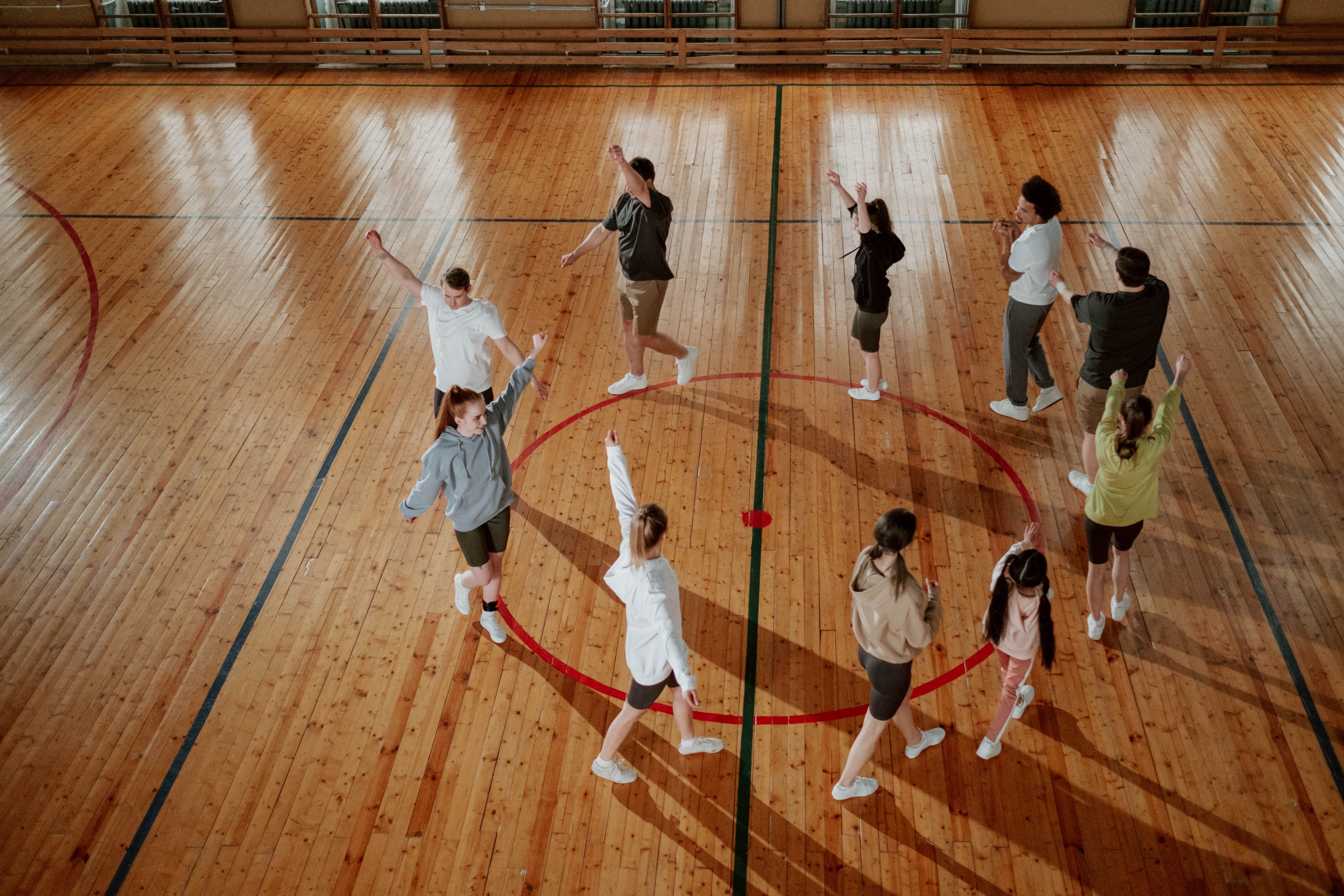
Picture this: You are engaged in focused questioning with a group of students. The other five groups are spread around the gym working on their tactics and strategies across multiple game categories. Out of the corner of your eye, you see one student running towards you with a tooth in their hand—you have no idea if it just fell out or if they were hit. Your spidey senses are also tingling…you better duck because there’s a ball heading your way! You can’t even take a breath—how are you supposed to assess learning?
Feel familiar? Well, take a deep breath and keep reading!
Assessment: Improving and Communicating Learning
We all know that assessing student learning is part of a teacher’s professional responsibility. Let’s look to PHE Canada for some guidance:
PHE Canada suggests that “There are two main purposes for assessment of student learning: improving learning and communicating learning” (PHE Canada, n.d.). In this article, we will explore two meaningful ways teachers can improve and communicate learning:
- Backward Design
- SIPs of Feedback
Backward Design: Aligning Purpose, Assessment, and Content
You’re already planning lessons and units, so why not make them more purposeful and aligned?
Backward Design (Wiggins & McTighe) is a framework that can save time and energy. Think of it as your pre-game prep that makes the chaos of the game more manageable. For instance, when planning, you may have learned to choose the content first. But what if you choose content last?
With a Backward Design approach, you will choose the goal or purpose (e.g., indicators, objectives, outcomes, success criteria, etc.)—what we want the students to know and be able to do first. This then guides the rest of your planning. Your second decision is to create an assessment that will help you determine progress toward the goal. And last, but certainly not least, is your physical education content—what content (e.g., athletics to yoga) can you use to support student learning?
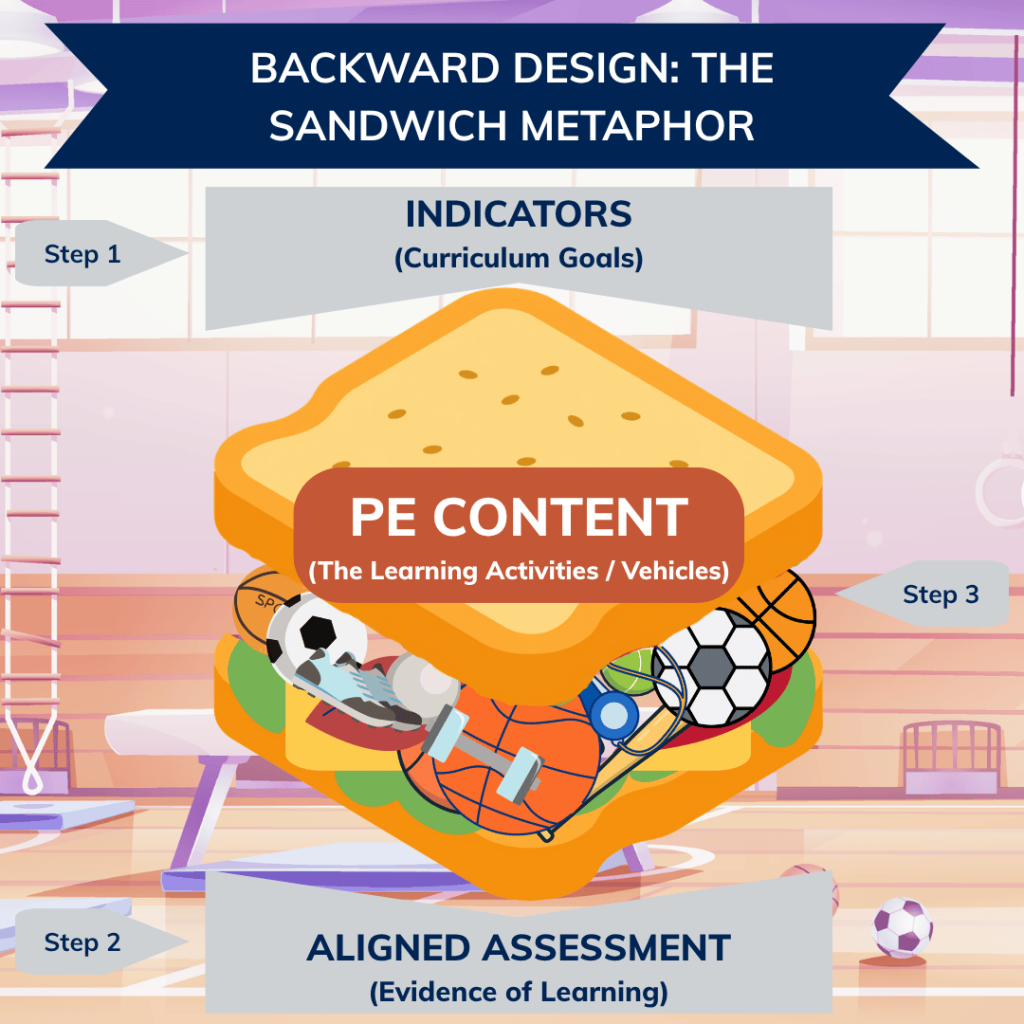
I often use the metaphor of a sandwich to clarify and solidify the concept of Backward Design. For example, one piece of bread represents the indicator(s), while the other piece of bread is the aligned assessment. If the assessment and indicator(s) aren’t in alignment, the "sandwich" falls apart! The ingredients in the middle of the sandwich represent the physical (and health) education content.
Generally speaking, when making a sandwich, we would first take out two pieces of bread. Then we would fill in the middle.
Similarly, with Backward Design, we first choose the goals (e.g., indicators / objectives / outcomes / success criteria from the curriculum) and design an assessment that will provide information about student learning—the two pieces of bread. It’s only after decisions have been made about indicators and aligned assessments that we begin making decisions on what physical (and health) education content to use as the vehicle for improving and communicating learning.
So, you’ve planned using Backward Design. Indicators—check; Assessment—check; Content—check. Now, it’s time to put the plan into action!
You’ve arrived in class, but again, there’s just so much going on; how will you assess? Don’t sweat it, you’re prepared! You know what your indicators are and what the aligned assessment is, so you are ready to focus your observation, analysis, and supportive feedback.
SIPs of Feedback: A Short Acronym That Can Make a Big Difference in the Quality of Feedback
An acronym I use to help provide quality feedback is SIPs: Specific, Immediate, Positive/Purposeful/Powerful, in small doses.
- Specific: the indicator(s)/outcome(s) rephrased in developmentally and contextually appropriate ways,
- Immediate (as possible given the context); deliver feedback while “it” (physical, cognitive, affective, social) is occurring
- Positive/Purposeful/Powerful: use praise, prompts, and pointers (i.e., helpful tips), and
- In small doses: walk away, allow time for integration, return to check in.
What might SIPs of feedback look like in action? As students are engaged in learning, you’re zoned in on providing SIPs of feedback. You observe students across the gym and make your way over (Immediate), thinking about how to phrase the feedback so that it is aligned with the indicator (Specific), with both positive and constructive focused feedback weaved in (Powerful). When you get there, you gather the group of students together to say, “I noticed you are varying your force based on the distance from the target. This strategy is important for getting as close to the target as you can and scoring points. What other tactics can you use to have more beanbags in play than your opponent?” After having a conversation to ensure understanding and/or negotiate next steps, you share a smile, tell them you’ll be back to check in on them, and walk away, giving the students time to experiment without you watching over their shoulder (small doses). A few minutes later, after having observed other students and offering them SIPs of feedback, you return to the first group of students. You have a conversation about tactics and strategies, guided by the SIPs of feedback you already provided, and use your assessment sheet to make a few quick anecdotal records (i.e., assessment FOR learning). During class, students are encouraged to add a self-assessment to their personal portfolio (i.e., assessment AS learning). These aren't just check-box exercises; they are Assessment FOR and AS Learning in action. Your use of SIPs of feedback have successfully bridged the gap between where the student is and where they can aspire to be. When students capture these moments in their personal portfolios, they are ultimately making feedback more personally meaningful.
You have now successfully gathered and recorded solid evidence of student progress for another 7-10 students—but more importantly, you have used a feedback framework and reflective practice with the intention of supporting student learning, increasing engagement, and developing stronger relationships. It took a lot of moving parts: pre-planning by choosing indicators; aligned assessments; and content to support student learning; in-class focused observation, analysis, and feedback; as well as student involvement through opportunities to progress their learning through movement and discussion, culminating in self-assessment. You handled it like a pro—in a meaningful and manageable way. A good day of teaching, learning, and assessing!
Conclusion
Assessment, like any other quality teaching method, takes work and practice, but using frameworks such as Backward Design to align indicators, assessment, and content which guides focused SIPs of feedback, can make assessment more manageable, even in the busy context of physical (and health) education. When it comes time for grading and reporting, you’ll have the formative and summative assessment information you need to make evidence-based judgements (i.e., evaluation).
Now, off you go to make one delicious sandwich after another, for and with your students!
Additional Resources:
- To support teachers with improving and communicating learning, PHE Canada provides a series of six concise information booklets on assessment:
- Formative vs Summative Assessment: What's the Difference
- Assessment for Learning
- Assessment as Learning
- Co-constructing Success Criteria
- Collecting Evidence of Learning
- Feedback
PHE Canada’s Assessment in Physical and Health Education e-Learning. This course introduces key principles and practices that help educators recognize how assessment shapes teaching, informs instructional decisions, and empowers students. And stay tuned, because there is more to come from PHE Canada on assessment.
Acknowledgements
Special thanks to Jacinta McGrath (NL Education and Early Childhood Development), Katherine Baker (English Montreal School Board), and PHE Canada staff for their generous time and thoughtful suggestions, which improved the quality of this work.
References
PHE Canada (n.d.). Professional learning: Assessment in Physical and health education. https://phecanada.ca/professional-learning/assessment-physical-and-health-education
Wiggins, G. P., & McTighe, J. (2005). Understanding by design (2nd ed.). Pearson.
Authors