Hula Hoops as Versatile Equipment for Target Games
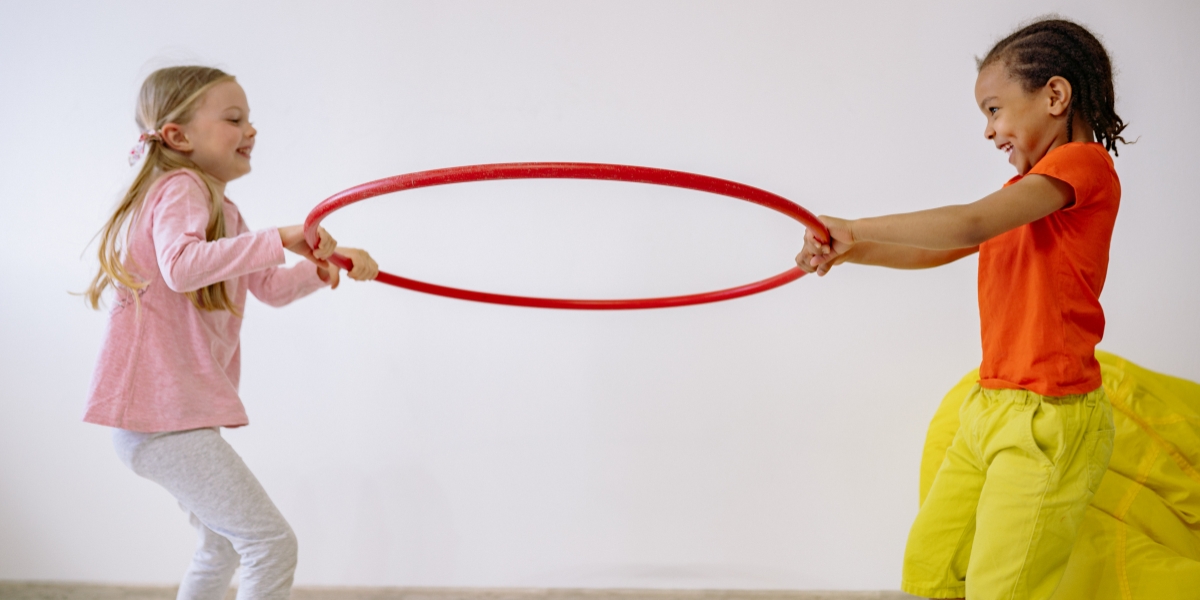
Hula hoops are incredibly versatile pieces of equipment. They can be used as stationary targets lying flat on the ground, rolling targets for chase or toss games, or even aerial targets when tossed into the air.
Bigger Target
Hula Hut as a Target
Hula Huts are a creative and engaging way to add structure to target games. To build one, begin by placing a hula hoop flat on the ground as the base. Then, lean two hoops against each other with their bottom edges resting inside the base hoop. Next, add two more hoops in the same way but positioned perpendicular to the first two. Finally, lay one more hoop across the top, parallel to the base, to hold the structure together. These Hula Huts can be used for many different target games in which the Hula Hut is the target to knock down. If you have very large hoops, encourage smaller students to crawl through the hut without knocking it over.
Rolling Hoops
Hula Hoop Horseshoes
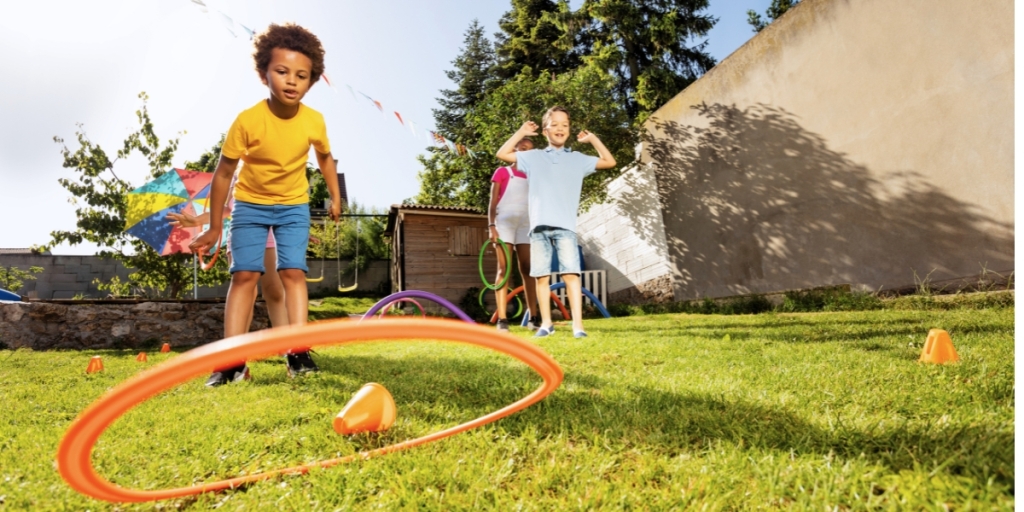
Place a pylon about ten paces away from a designated throw line. Two players stand at the line, each with one or two hula hoops. Determine who throws first. The goal is to roll the hoop so that it lands over or close to the pylon. After the first round, the player who scored higher goes second. If no points are scored, the same order continues.
Scoring:
- A ringer—when the hula hoop fully encircles the pylon—is worth three points. If both players get a ringer, either no points are awarded, or you can choose to count only the first or the last ringer.
- One point for each hoop closer to the pylon than their opponent's.
- The first player to reach 21 or more points wins.
Hula Hoop Horseshoe Ringer Race
This version is similar to Hula Hoop Horseshoes but with a twist—only ringers count for one point, and players do not take turns. Instead, they race to be the first to score a set number of ringers.
Toss Ball Through Rolling Hoop
One player holds a hoop while two others stand a few steps away. One of those two players holds a ball. When ready, the hoop holder rolls the hoop across the court. The other two try to toss and catch the ball through the moving hoop as many times as possible. To make it easier, allow the ball to bounce before being caught.
Rolling a Ball into a Hoop
Roll and Flip
Pairs of players stand behind a starting line with a hula hoop placed just beyond it. The first player rolls a ball, aiming to stop it inside the hoop. If successful, they flip the hoop forward and toss the ball to their partner. If not, they leave the hoop in place and still pass the ball. Players alternate turns, moving the hoop forward each time they land the ball successfully. Continue for a set amount of time or until one pair crosses the finish line.
Roll Risk & Reward
Pairs begin behind a starting cone. The first players hold both a ball and a hula hoop. On the leader’s signal to begin, the players slide their hoop forward and when it stops sliding, attempt to roll their ball and have it stop inside their hoop. If successful, they move their cone up to the hoop, retrieve the hoop, slide it farther ahead, and toss the ball to their partner, who then attempts to roll the ball into their hoop. If the ball does not land inside the hoop, the hoop stays where it is, and the player tosses the ball to their partner, who then takes a turn trying to roll the ball into the same hoop. This game encourages strategic decisions: play it safe with short easier rolls, or take bigger risks for faster advancement.
Roll Ball into Hoop – Cued Version
This variation is the same as Roll and Flip, except players use a pool noodle, like a cue stick, to tap the ball into the hoop. This version can also be adapted for Risk & Reward to add a fun challenge.
Passing Balls Into or Through a Hoop
Bounce Pass Relay
Pairs of players stand on either side of a space such as a volleyball court. A hula hoop is placed at the midpoint between them. One player starts with a ball. On the leader’s signal, both players run toward the hoop, with one carrying or dribbling the ball. When close enough, the ball is bounce-passed into the hoop toward their partner. After a successful catch, both return to their start lines and repeat. Count how many successful bounce passes are completed in the time limit.
Toss Hoop and Ball/Noodle
Two players stand facing each other about 3–5 paces apart. One holds a hula hoop; the other has a ball or pool noodle. On the signal, the hoop is tossed in the air towards their partner, who tries to throw their object through it as it flies through the air. The hoop tosser attempts to catch the ball and the ball tosser attempts to catch the hoop.
Toss Hoop and Balls/Noodles with Pairs
Two pairs of players stand opposite each other. One pair holds a hoop; the other each holds a ball or noodle. On the signal, the hoop is tossed in the air towards their partners, while the other pair attempts to throw their objects through it. Count how many successful attempts can be made in a set time.
Moving the Body Through a Hoop
Lift Over Then Jump Back In
Set a start and finish line about 10–15 paces apart. Place hoops on the start line in front of each player pair. One partner stands in the hoop; the other stands behind. On the signal, the player in the hoop lifts it and places it forward on the ground. Their partner runs ahead and jumps backward into the newly placed hoop, then lifts it and repeats the process. Continue until the team reaches the finish line.
For over sixty additional target game ideas, visit Canada GO4Sport.
For a wide selection of highly durable hula hoops—guaranteed to be safe and kink-proof—explore the options available through Gopher.
Authors