Goalball: A Life-Changing Sport Gateway for the Visually Impaired
About 68% of Canadian children participate in sport (Canadian Fitness and Lifestyle Research Institute, 2022). For children with disabilities, that number drops sharply. Data shared at the 2025 Sport for Life Summit shows that more than 70% of children with sight loss do not participate in sport or recreation because they feel excluded (Canadian Blind Hockey, 2025). And even though more than 8 million Canadians live with a disability (one in five Canadians; Government of Canada, 2022), barriers such as limited programming, high equipment costs, and inaccessible systems still make sport harder to access than it should be (Paralympic Foundation of Canada, n.d.). The systems meant to connect people to parasport are fragmented, underfunded, and too reliant on chance. For example, a recurring challenge within the parasport community is that programs across the country struggle to recruit athletes—not for lack of eligible people, but because many never learn what sport opportunities exist or how to access them.
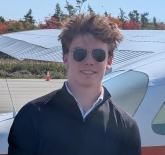
I wrote this article to share my journey to goalball, a competitive parasport designed for athletes who are blind or visually impaired. This sport changed my life, and I want to use my story to discuss some barriers that visually impaired people face across all disciplines and how parasport, when accessible, builds skills, community, and a sense of belonging that extends well beyond competition.
When the Signs Are in the Gym
Growing up, I was a high-level gymnast with dreams of representing Canada on the national team and at the Olympics. Gymnastics was my passion—it was everything. But at ten years old, signs began to emerge that something was wrong.
My first signs of vision loss emerged during gymnastics training. I was losing air awareness on skills I had done hundreds of times. I walked into lowered high bars. On the vault, I had to look up and down separately to find the springboard and the table because my visual field had narrowed too much to see both at once. One day, I caught my eye on a cubby hook in the change room, something I had not seen.
Adults around me also noticed a change. My coaches saw my landings falling apart without understanding why. My Physical Education (PE) teacher noticed I was running into other students and knew it was not a behavioural issue. My mom later pieced it together. The diagnosis was Retinitis Pigmentosa (RP), a progressive retinal disease that destroys photoreceptors. RP typically starts with night blindness and a gradual narrowing of peripheral vision. For safety reasons, I was advised to stop gymnastics, and this was heartbreaking. Gymnastics was my passion; I did not want to stop, and my Olympic ambitions were shattered.
From the Gym Floor to the Goalball Court
After my diagnosis, I was introduced to goalball—a sport I had never heard of before. With great coaching and a strong support network to help redirect my passion, I was set on a new trajectory.
At the age of fourteen, I made the Canadian Senior Men's Goalball team in 2024, making me the youngest ever on the team. In 2025, I scored the winning goal against Mexico at the 2025 Youth Parapan American Games in Chile. Fast forward to 2026, when I was seventeen, I competed in my first World Championships in Hangzhou, China, and won the Senior Men’s National Championships in Saskatchewan, where I was named MVP of the tournament. This happened not because the system was designed to find me, but because a chain of referrals connected me to the sport. I was lucky. Most families are not.
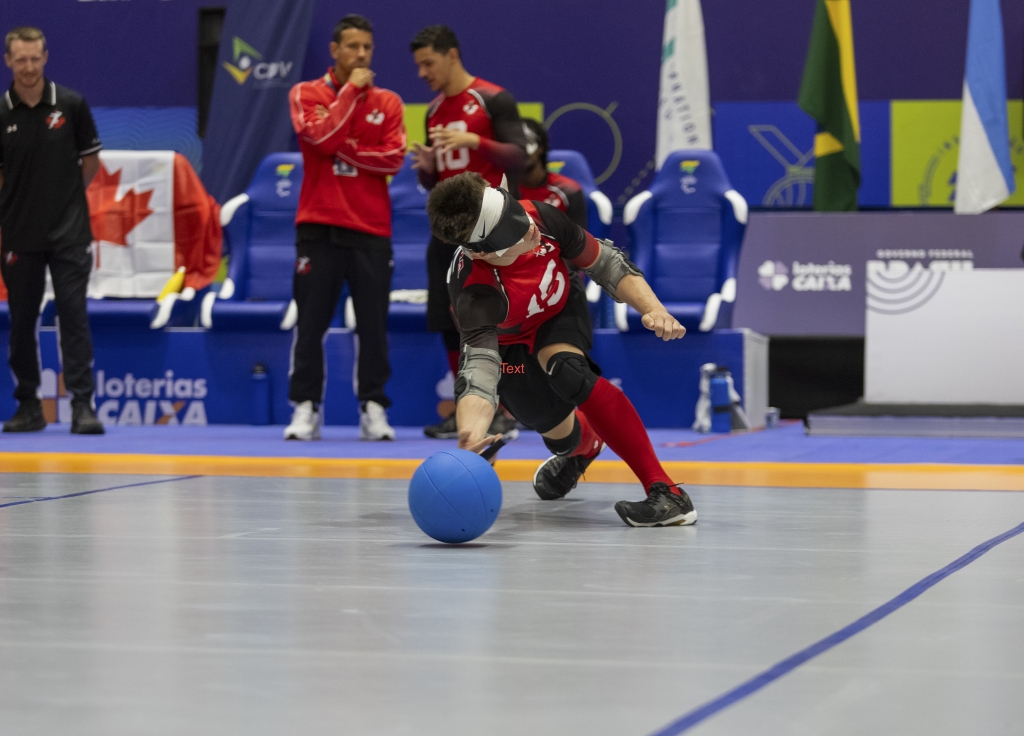
The Pathway Problem: Why Access to Parasport Shouldn't Depend on Luck
The referral chain that brought me to goalball is not a system that every family with a newly diagnosed child gets—and that gap is the problem. After my diagnosis, my doctor knew how important sport was to my life, and I was fortunate that they referred us to the Atlantic Provinces Special Education Authority. Within a few months, we were connected with a goalball coach, and I was on the court. That referral chain held together, and I am grateful it did, but this is not something every family can count on. My entry into goalball depended on a doctor who knew where to send us, a province that had the right services, and a coach who happened to work within them. If any one of those links had been missing, I may never have discovered goalball.
Across much of Canada, efficient referral networks for parasport are largely absent. This gap is reflected in goalball, which remains under-resourced, experiences lower participation rates, and has almost no Canadian research tied to the sport. Currently, many goalball programs are concentrated in a handful of major cities. Coaching positions are underfunded, with individual coaches often responsible for entire regions. Most doctors focus on diagnosis and treatment, and referring families to alternative sports is not typically part of their process. The result is that many young Canadians with vision loss never learn that goalball exists, that it is a competitive, internationally recognized sport, or how to access it.
More Than a Sport: How Goalball Helps People
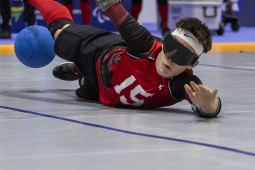
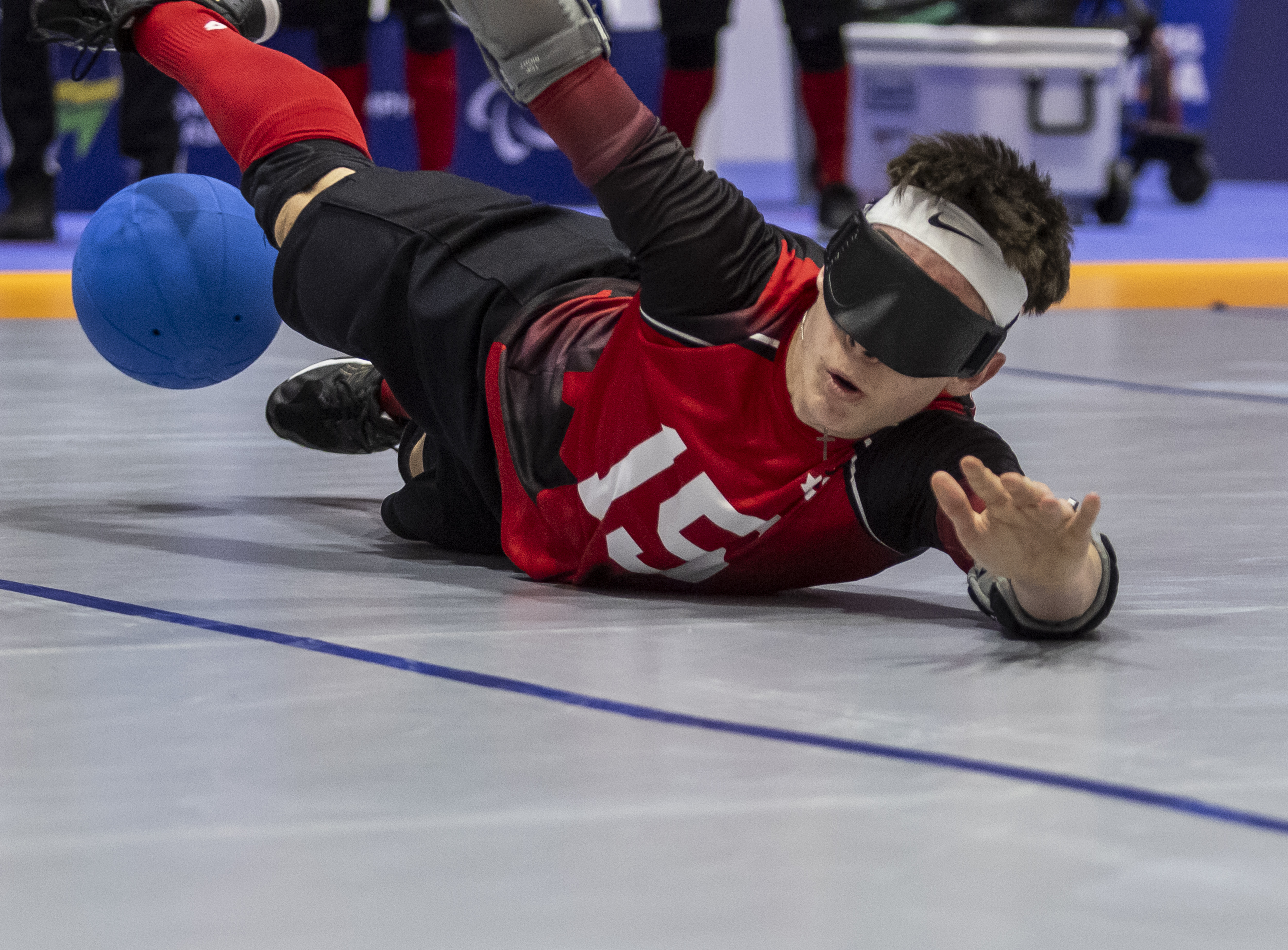
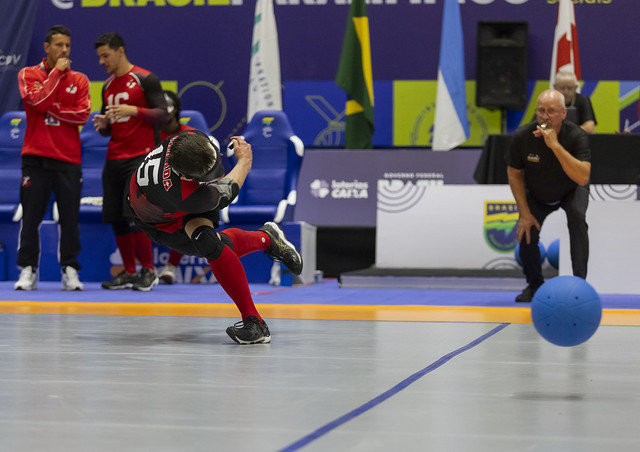
Goalball was invented in 1946 to rehabilitate visually impaired World War II veterans. Today, it is a Paralympic team sport played around the world. Three players per side compete on a court (e.g., the size of a volleyball court) that has tactile markings and goals spanning the full width of each end. Every athlete, regardless of their vision level, wears blackout eye shades, making the competition equalized. The ball is heavy, weighing about 1.25 kilograms, and it has bells inside to help orient players. To score, the ball is rolled or bounced along the floor toward the opposing goal, and the defending team throws themselves in a coordinated line to block it. The referee demands silence during play so players can track the ball by sound, concentrate, and react. Between throws, teammates communicate through quick verbal calls and taps on the floor. The game is fast, physical, and entirely non-visual.
Goalball builds life skills that blind and visually impaired young people can carry well beyond competition. Players orient themselves using tactile lines on the court, track a moving object by sound, and coordinate their bodies without visual feedback. These are the same skills required to cross a street, navigate hallways, or move through crowds. For a young person with a progressive condition like RP, goalball teaches you how to function as your vision changes, not in a clinical setting, but in a gym competing with your peers.
That peer environment matters as much as the physical training. Goalball connected me quickly to other young people who were blind or visually impaired. For a young person dealing with vision loss, one of the biggest challenges is not having anyone around who shares your experience. Goalball changes that. You train alongside athletes who navigate the same things you do, and you learn strategies from them that no textbook covers. A child who meets other visually impaired athletes at a young age can learn that blindness does not define a person, nor does it limit you. Goalball creates an environment where peer connection can occur naturally because of its nature as a team-oriented sport.
My gymnastic skill set was directly transferable: strength, spatial awareness, and explosive movement are crucial in goalball. With great coaching and support, I was set on a trajectory for success. The coach who introduced me to the sport is now my teammate on Team Canada. I was truly fortunate to have such a strong support network to redirect my passions, and I have set new Paralympic goals.
What Physical and Health Education Educators Can Do
Physical and Health Education (PHE) educators are often the first adults apart from family to notice when a child may be experiencing vision loss. A student who bumps into classmates. An athlete whose coordination suddenly declines. A kid who avoids dimly lit spaces or who cannot track a ball the way they used to. These may not inherently be problems with self-discipline or a lack of effort; rather, they may be early signs of a condition the student does not yet know they have.
In my case, even a teacher who knew goalball well and had coached me in other sports did not initially connect my changed behaviour in class to a possible vision condition. That was not a failing on their part; it simply illustrates how challenging visual impairments can be to recognize even for people who are experienced in the field. PHE educators and coaches are uniquely positioned because they can observe how students move, navigate space, and respond to dynamic physical and social environments. However, PHE educators and coaches need more training when it comes to supporting students with different types of visual impairments and disabilities in general to heighten their awareness and ability to design inclusive programming in their PHE classes or connect them with available community resources. Quality apps that are useful educational tools that have been built for this purpose (e.g., As I See It) and resources from PHE Canada, such as School-Based Physical Activity Experiences for Students of All Abilities and Quality Physical Activity Experiences for Children and Youth of All Abilities e-Learning (coming soon), can be places for PHE educators and coaches to start.
Concretely, it would be helpful and meaningful for PHE educators to be aware of goalball and other parasport programs that exist in their region. PHE educators should build relationships with organizations like the Canadian Blind Sports Association, the Canadian Paralympic Committee, and their provincial and community parasport organizations so that they can connect students with vision loss and other disabilities to sports designed around their abilities. When a student’s movement patterns change in ways that do not add up, a simple conversation with a parent/caregiver could be the turning point that starts the referral chain.
Closing the Gap
The referral pathway that connected me to goalball required the right doctor, the right provincial services, and a local coach. I am grateful for every person in the chain that brought me to goalball. I was very lucky, but ideally, a functional system should not depend on luck.
It would be ideal if there were routine referrals from the medical system to organizations like the Canadian Blind Sports Association at the point of diagnosis. More funded coaching positions would help, so that individual coaches are not covering areas across entire provinces. Similarly, more programs outside major cities should be supported so that geographical location does not create a barrier to accessing organized goalball opportunities. Whether the end goal is high-performance competition or simply having peer support in a team environment, access to goalball after a diagnosis should be a reliable pathway, not a fortunate accident. Physical and health educators can be part of building that pathway.
References
Canadian Blind Hockey. (2025). Presentation at the Sport for Life Summit. Sport for Life Summit.
Canadian Blind Sports Association. (n.d.). Canadian Blind Sports Association. https://canadianblindsports.ca
Canadian Fitness and Lifestyle Research Institute. (2022). Sport participation among children and youth: 2022 parent survey of physical activity and sport participation. https://cflri.ca/publication/sport-participation-among-children-and-youth/
Canadian Paralympic Committee. (n.d.). Goalball. https://paralympic.ca/sport/goalball/
Government of Canada. (2022, December 16). Government of Canada. Canada.ca. https://www.canada.ca/en/employment-social-development/programs/disability/arc/disability-2006.html
Harry Nickerson. As I See It. (2026). https://asiseeit.ca
Paralympic Foundation of Canada. (2026). The programs powering para sport in Canada. https://paralympic.ca/news/the-programs-powering-para-sport-in-canada/
PHE Canada. (n.d.). Equity, diversity and inclusion: Students of all abilities. https://phecanada.ca/professional-learning/equity-diversity-and-inclusion/all-abilities
Authors