type

  • Feature Article
  • Podcast
  • Research

theme

  • Instant Activity
  • Food Literacy
  • Outdoor Learning
  • Physically Active Learning
  • Social Emotional Learning
  • Cross-Curricular Learning
  • Models-Based Approach
  • PHE Community
  • Healthy School Communities
  • Fundamental Movement Skills
  • Dance Education
  • Digital Literacy
  • Health Education
  • Financial Literacy
  • Physical Education
  • Sex Education
  • Educational Leadership
  • Equity, Diversity and Inclusion
  • Teacher Education
  • Mental Health
  • Substance Use
  • Truth & Reconciliation

Search Results

SORT BY:

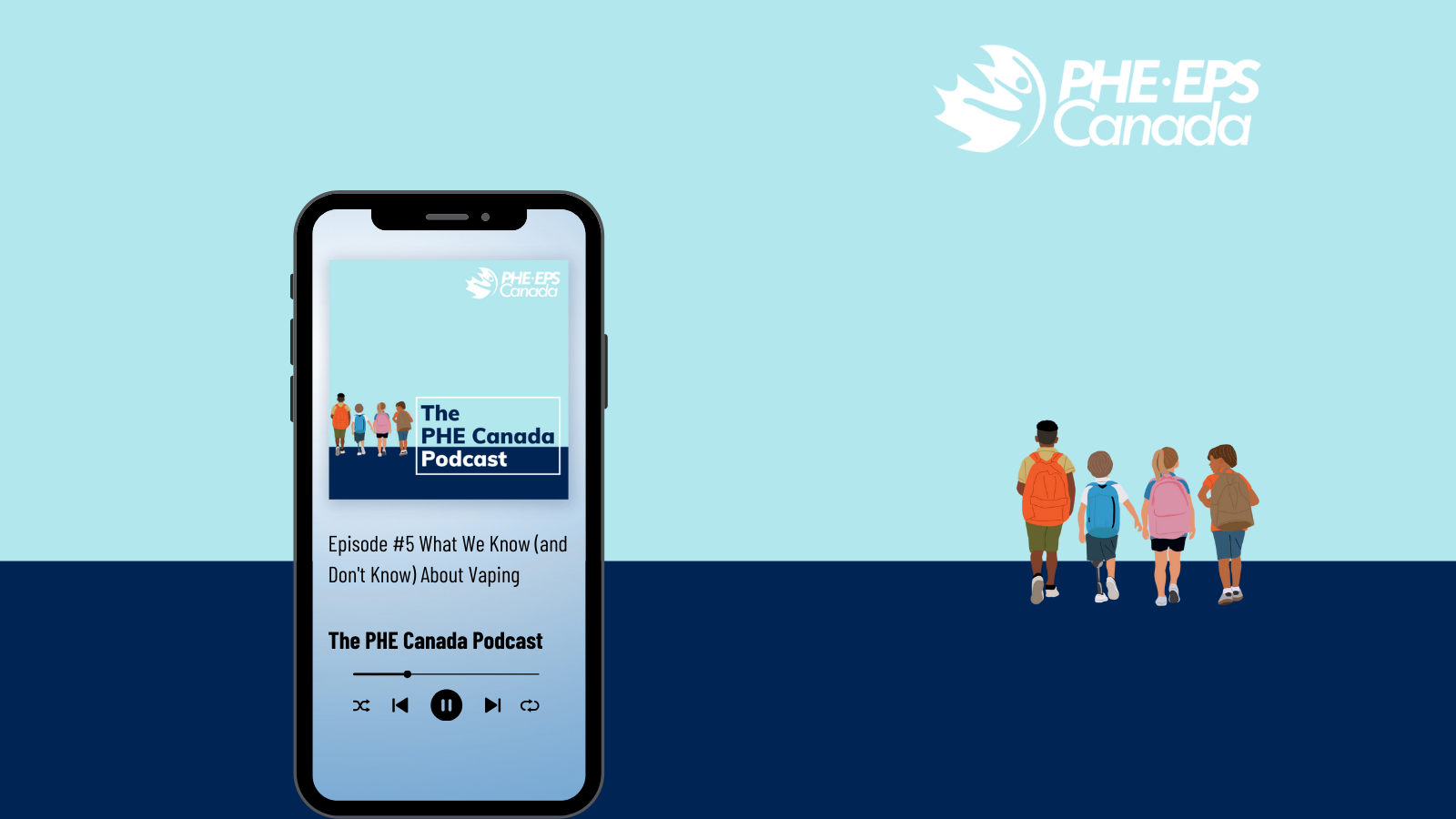
The PHE Canada Podcast, Season 1 - Episode 5: What We Know (and Don't Know) About Vaping
May 17, 2024
The PHE Canada Podcast, Episode 5: What We Know (and Don't Know) About Vaping

Did you know that about 15% of high school students have been vaping in the last month and around 35% of youth between the ages of 15 to 19 in Canada have vaped?

Welcome to The PHE Canada Podcast! In the fifth episode of our podcast, we speak with Dr. Tea Rosic, Child & Adolescent Psychiatrist at the Children’s Hospital of Eastern Ontario (CHEO) and Clinician-Investigator at the CHEO Research Institute and the University of Ottawa, and Ryan Fahey, Lead, Programs & Resources at PHE Canada, who works closely with school communities taking a comprehensive school health approach to address commercial tobacco use and vaping in their schools through the Students Together Moving to Prevent Tobacco Use (STOMP) program. Alongside our host, Josh Read, our guests open a dialogue around the issues we are seeing across the country - as early as elementary school. Dr. Rosic and Ryan share their unique perspectives and insights on navigating the complexities around vaping and nicotine amongst youth such as:

  • How withdrawals can impact the school day;
  • Challenges educators are facing;
  • Strategies educators and schools can use when supporting students;
  • Tools to address vaping in your school;
  • Youth vaping statistics and prevalence in Canada, and much more!

Check out the following resources discussed in the episode:

                Listen on YouTube


Additional Canadian Vaping Statistics: 

  • As of 2020, 5.2 million Canadians aged 15 and 19 had vaped and more than 1 in 3 of high school aged youth vaped within 30 days of reporting. (CTNS, 2020) 
  • 1/3 of youth aged 15-19 who vape cited their main reason for vaping in the past 30 days was to reduce stress. (CTNS, 2021) 
  • Among youth aged 15 to 19 who used a vape, most (55%) reported buying their devices from a friend or family member, asking someone else to buy them for you, and having a friend or family member give or lend them to you. (CTNS, 2020) 
  • The prevalence of trying vaping at least once among youth aged 15 to 19 was 35% (711,000). (CTNS, 2020) 
  • Among Canadians aged 15 years and older who used a vape in the past 30 days, 83.1% [95% CI: 78.6, 87.5] (1.3 million) reported vaping an e-liquid containing nicotine. (CTNS, 2021)    


Recent Posts

Paper cutouts of diverse people, including some in wheelchairs, holding hands, surrounded by colored pencils. Wooden letter blocks spell out 'INCLUSION'.
How Do I Include Everyone?
[ Feature Article ] Fostering equity, inclusion and belonging in physical education can be challenging, but it is essential for students to feel seen, understood, and supported when they are developing physical literacy. This article shares practical, adaptable strategies that promote inclusive practices—such as flexible dress codes, culturally responsive practices, student voice in planning, and accessible leadership opportunities. It emphasizes creating safe, welcoming spaces through community partnerships, Indigenous perspectives, inclusive language, and visual representation. While not a one-size-fits-all guide, these ideas offer a starting point for creating more welcoming and equitable PE environments that reflect and respect the diversity of our school communities and lived experiences.
Authored by: Brenda Carbery-Tang
Group photo of the Student Chapter Showcase
Building Connection, Leadership, & Belonging: The Student Experience at the 2026 PHE National Conference
[ Feature Article ] This year’s Physical and Health Education National Conference in Vancouver marked an exciting step forward for enhancing the student experience and strengthening connections among the next generation of PHE leaders. Through intentionally designed networking opportunities, active experiences, mentorship moments, and student-led initiatives, the conference created meaningful spaces for pre-service educators to build relationships and deepen their sense of belonging within the profession.
Authored by: Caleb Poulin, PHE Canada
A group of three school-age children can be seen walking together outside a school. They appear happy and are clearly enjoying each other's company.
HEx Prescribing Health Education in Canada: Moving from Insight to Action - A PHE Canada Thinkers Report
[ Feature Article ] We invite you to read this document and join us in advocating for the 25 recommendations and championing the actions that will guide us towards achieving meaningful and sustainable solutions within our school communities.
Authored by: PHE Canada
A teenage boy is sitting on the floor with a schoolbag next to him. He is holding a phone and looking at it intently.
Digital Media and Navigating Smartphone Use in Schools
[ Feature Article ] Digital innovation in education is here, and it is transforming how, what and where we learn. We are witnessing a surge in artificial intelligence, with technology increasingly becoming the primary mechanism that directs learning, rather than merely supporting it. However, not all innovation has positive outcomes, nor is it all created equal. This article offers strategies to help young people build digital resilience in the digital media age.
Authored by: Ryan Fahey
A young child with blonde hair in a bun, wearing denim overalls and a yellow shirt, looks over their shoulder while carrying a bright blue and green dinosaur backpack with orange spikes.
To Learn, To Love, To Move: Branding a Future in Physical Education
[ Feature Article ] This article explores how the phrase “To Learn, To Love, To Move” can reframe physical education (PE) as inclusive, joyful, and meaningful. Rooted in physical literacy and child development, it captures cognitive, emotional, and behavioral learning. The slogan offers a unifying identity for PE, resonating with students, educators, and policymakers. Practical implications for curriculum, staff development, and collaboration are discussed, positioning the phrase as both a guiding philosophy and a catalyst for cultural change in PE.
Authored by: Aaron Beighle, Ph.D., Mike Chamberlain, Dr. Heather Erwin
Two colorful puzzle pieces with a mosaic pattern of different shapes and colors on a light wooden background.
Stronger Together: Connecting Subjects to Ignite Student Learning
[ Feature Article ] In schools, across all grade levels, cross-curricular connections result in countless benefits for student learning. Cross-curricular connections are purposefully planned lessons that fuse two or more subjects, providing students with meaningful learning experiences while ‘connecting the dots’ between subjects. In this blog, I share a brief introduction and a few teaching considerations pertaining to cross-curricular connections, along with two examples—one for K-6 and one for Grade 7 and above. Alongside some supporting materials, I conclude with a list of ‘Three To-Dos’ for educational stakeholders to consider when thinking about the innumerable amount of benefits that can arise from cross-curricular connections in the learning environment.
Authored by: Brent Bradford