type

  • Feature Article
  • Podcast
  • Research

theme

  • Instant Activity
  • Food Literacy
  • Outdoor Learning
  • Physically Active Learning
  • Social Emotional Learning
  • Cross-Curricular Learning
  • Models-Based Approach
  • PHE Community
  • Healthy School Communities
  • Fundamental Movement Skills
  • Dance Education
  • Digital Literacy
  • Health Education
  • Financial Literacy
  • Physical Education
  • Sex Education
  • Educational Leadership
  • Equity, Diversity and Inclusion
  • Teacher Education
  • Mental Health
  • Substance Use
  • Truth & Reconciliation

Search Results

SORT BY:

The Top 5 Reasons to Visit TeachResiliency.ca…Often.

TeachResiliency.ca

The Top 5 Reasons to Visit TeachResiliency.ca…Often.

Today we launch the first entry in our blog series, and are proud to introduce you to TeachResiliency.ca. These blog posts will keep you informed about current trends, issues, tools and strategies to assess the resilience of students and teachers. We invite you to come in, connect, and participate. This site is for you. 

What better way to launch the blog than to highlight some of the reasons that TeachResiliency.ca will be helpful in your practice and profession? Let’s take a look at the top 5 reasons to visit TeachResiliency.ca!  

1. A lot of teachers are doing a lot of great teaching, supporting, and leading. Celebrate, get inspired.

There are nearly 400,000 teachers in Canada, responsible for about 5 million school children. The work and magic of teaching isn’t often a “Hollywood moment”. Long hours, the needs of many students, doing-more-with-less (of everything!) layers on top of busy lives, lively classrooms and waves of colds, flu, head lice, and muddy boots. The real work is often quiet, invisible and isolated. The real work is hard and requires us to be so flexible we fear we might break, so resilient we fear we might harden, and so enthusiastic we worry we might burn out.

2. Teachers make a difference. 

I’m fortunate to have had many teachers who made really important connections and differences in my life. How about you? From Grade 1 through university I was fortunate to have wonderful teachers. Mrs. MacDonald opened the world of reading to me in Grade 1, Mr. Crowell showed me the universe in Grade 6, and Miss Mitchell helped me see myself as a capable student when I was a teen. They noticed, listened, inspired and supported me and, in what was often turbulent and unpredictable life, they made school my safe haven; they were my mentors, motivators, and muses. Teachers don’t just deliver curriculum; they encourage students to take risks, create communities of learners, support and scaffold so each student is achieving more than they thought possible, and witness big and small victories and defeats every single day.

3. Wellness must be supported, nurtured and championed. 

The research tells us that 20 % of Canadians- from age 4 to 84- will develop a mental illness during their lives. It also shows us that only 1 in 5 people who suffer a potentially debilitating and destructive illness get help through the health care system. If 5 children broke their arm on the playground, would we stand by and watch as only 4 of them got medical treatment? If 5 adults had diabetes, would we be content if only 4 of them received medication?

Of course, the 20% figure includes adults, and those adults, include teachers. How many times have you heard anyone talk about teacher wellness or the challenges and barriers to the mental health of teachers? To teach well, we must be well, and to be well, we must take care of ourselves and one another.

4. Most teacher education and professional development programs do not prepare teachers to talk about or support mental health in schools.

The research is clear on this: only a few teacher education programs expose candidates to the topic of mental health or provide relevant and useable strategies and tools for the classroom. Fewer still, include teacher wellness in the orientation to the professional knowledge of teachers. When talking to teachers who are working in schools, 90% express an interest in learning more about meeting the mental health needs of their students, and over 80% feel they are not achieving work-life balance; they feel they aren’t meeting the needs of their families or their students.

5. Teachers are critically important to a healthy school and without them, we cannot meet our goals for healthy students, schools, families, and communities. Your professional knowledge and commitment are integral.

When teachers are included in developing whole school approaches to student success, everyone benefits. They stand at the intersection of health and education and understand the importance of and pathways toward safe and secure housing, nutritious food, healthy families and equal opportunities for all. When students find success in the classroom, they are motivated to do well in other parts of their lives. When teachers are supported to create healthy classrooms, we all benefit. 

We look forward to seeing you again soon!

Recent Posts

a young man, diving on the floor during a goalball game. Wearing a team Canada red and black jersey, a white headband, and black coloured blind fold. The ball is blue. / Un jeune homme plongeant au sol lors d'un match de goalball. Il porte un maillot rouge et noir de l'équipe du Canada, un bandeau blanc et un bandeau noir sur les yeux. Le ballon est bleu.
Goalball: A Life-Changing Sport Gateway for the Visually Impaired
[ Feature Article ] At fourteen, Harry Nickerson became the youngest-ever member of the Canadian Men's Goalball Team—not because the system found him, but because a chain of referrals happened to hold together. This article uses his journey to explore goalball's transformative potential for young people with vision loss and the role physical and health educators (PHE) can play in making sport access a reliable pathway rather than a fortunate accident.
Authored by: Harry Nickerson
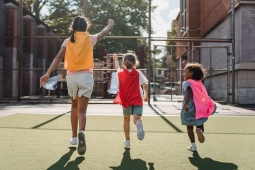
Three children in vibrant clothing joyfully running on a court, showcasing energy and playfulness. / Trois enfants en vêtements colorés courent joyeusement sur un terrain de jeu.
Walking is a Superpower!
[ Feature Article ] How can a simple walk be one of the most powerful choices we make? In this piece, eleven-year-old Ishaani Basu draws on research to explore how walking outside can improve physical and mental health, reduce harmful greenhouse gas emissions, and even free up government resources for people experiencing homelessness.
Authored by: Ishaani Basu
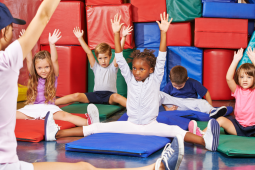
Children practicing various yoga poses in a gym class, demonstrating focus and balance. / Des enfants pratiquent des poses de yoga dans une salle de gym, concentrés et en harmonie avec leur environnement.
Who Plays, Who Doesn’t, and Why It Matters: The Case for Better Participation Data in Schools and Their Communities
[ Feature Article ] This article explores why high-quality, consistent, and useful sport and physical activity participation data matter for educators, schools, and communities. Although Canada has valuable national surveys and respected organizations that monitor participation, important gaps remain in understanding who participates, who does not, and where barriers to participation exist, particularly within school settings. Drawing on examples from Canada and abroad, the article examines how more coordinated and accessible participation data can support a range of actions that allow more children and youth to be active. It also highlights emerging initiatives that aim to provide decision-makers with more timely, integrated, and actionable sport and physical activity participation information.
Authored by: Jeffrey Gaudet, Dr. Sasha Gollish, Vanessa Coulbeck, Dr. Catherine Sabiston, Dr. Mathieu Bélanger
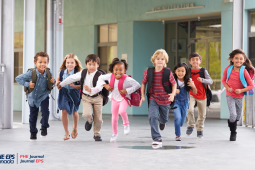
A group of children joyfully running down a brightly lit hallway, showcasing their excitement and energy. / Un groupe d'enfants court joyeusement dans un couloir, exprimant l'énergie et l'enthousiasme.
Active Bodies, Thriving Minds: Bridging the Physical Activity–Mental Health Gap in Schools
[ Feature Article ] How can we better connect the dots between movement and mindset in our schools? This article draws on research conducted in Ontario school boards and schools; however, the challenges and opportunities identified are relevant across Canada. While specific policies and programs may differ between provinces and territories, schools nationwide are grappling with many of the same questions around student mental health, physical activity, and how best to support young people to thrive amongst competing demands.
Authored by: Dr. Sasha Gollish, Sarah Ryan, Vanessa Coulbeck, Samira Sunderji, Dr. Catherine Sabiston
A group of people holding signs at a rally. One sign says "SAVE THE PLANET" with a blue drawing of the Earth. Another sign says "COOL KIDS SAVING HOT PLANET".
Examples of How a Comprehensive School Health Approach Can Be Used to Address Climate Change
[ Research ] Climate change represents a profound threat to the health and wellbeing of today's children and adolescents, yet its impacts on these populations are not fully understood. Evidence indicates that climate-related extreme events, and the stress associated with climate change, may significantly affect young people's mental health, educational attainment, and physical activity levels. Schools can play a pivotal role in addressing these challenges. One approach to addressing these challenges is using a Comprehensive School Health (CSH) model, which encompasses four pillars: teaching and learning, social and physical environment, healthy school policy, and partnerships and services. This paper presents illustrative ideas for programs, policies, or practices that could align with different pillars of the CSH model in relation to climate change. These examples are intended to prompt discussion and reflection, rather than to assert effectiveness, and may offer ways schools could consider supporting students in responding to climate-related concerns, including climate anxiety, and developing skills to navigate environmental challenges.
Authored by: Brenton Button, Will Burton, Gina Martin
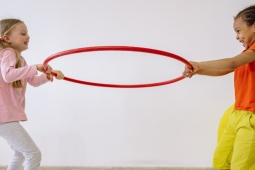
Two children hold a red hoop between them with their hands, smiling.
Hula Hoops as Versatile Equipment for Target Games
[ Feature Article ] Hula hoops are incredibly versatile pieces of equipment. They can be used as stationary targets lying flat on the ground, rolling targets for chase or toss games, or even aerial targets when tossed into the air.
Authored by: Dr. John Byl