Putting the E in Online Physical Education: Thinking Beyond Push-Ups and Jumping Jacks

Putting the E in Online Physical Education: Thinking Beyond Push-Ups and Jumping Jacks
Making sure that we don’t lose the “E” part of PE is difficult online - and in an emergency teaching environment like this, supporting students to continue to do daily physical activity (PA) is critically important. But is this helping our students to learn?
There is no question PA is vital - however, an important distinction must be made between Physical Activity and Physical Education. They are not the same.
Physical activity is a vital part of a healthy lifestyle that cannot be overlooked, especially in this time of social distancing and uncertainty. As the leading national organization advocating for quality physical and health education in Canada, Physical and Health Education Canada (PHE Canada) is pleased to see the organizations and individuals supporting the physical activity of children and youth. Dr. Tom Waeshawski, Chair, Childhood Obesity Foundation, notes "While we acknowledge that social distancing measures including school closures and stay at home recommendations due to the COVID-19 pandemic may increase sedentary behaviours, we also see this as an opportunity for looking at different ways of being active." To be sure, the continued release of at-home physical activity and fitness programs are sure to benefit Canadians - now and always.
In response to the quick need for resources, lessons, and activities in this emergency teaching environment, many organizations - educational, recreational, and fitness - have developed physical activities for students to do at home. Many of these programs are fitness-focused programs. While they are of value now, they should not be thought of as, or a replacement for, physical education (PE) classes - neither during this time of emergency teaching nor during times of “regular” schooling. Physical activity experiences provide the opportunity for people to engage in the application of the skills, knowledge, and ideologies taught in the Physical Education classroom.
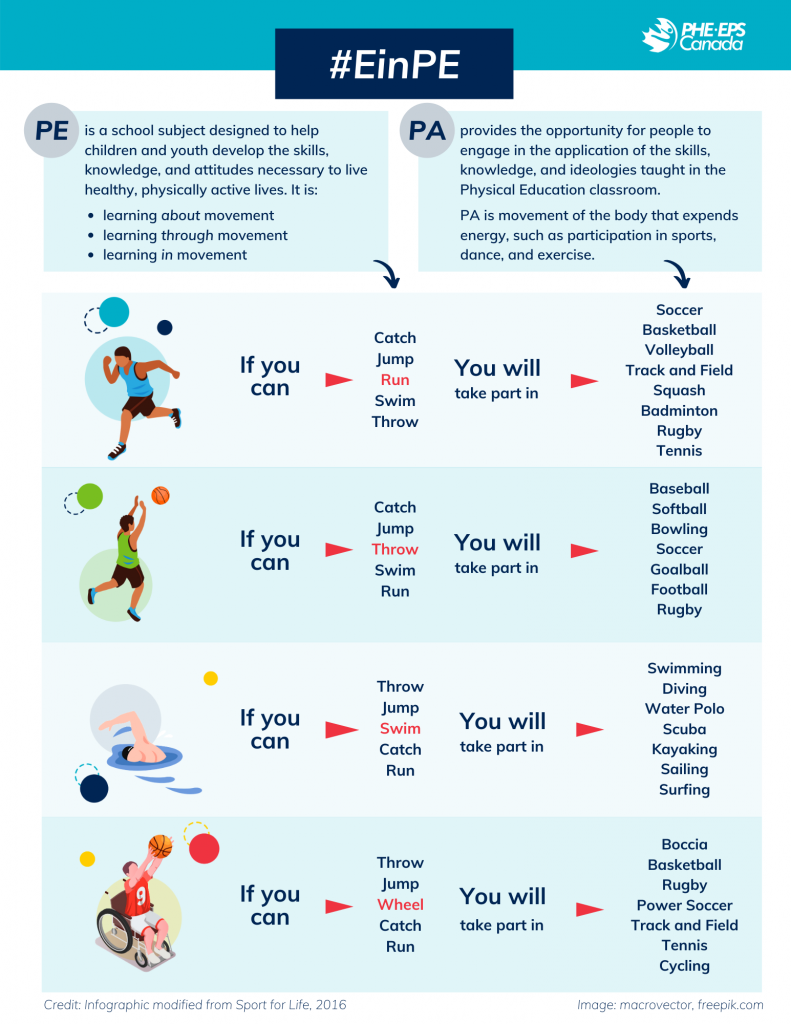
Image Source : Modified from Sport for Life, 2016
Physical Education is not just movement. It is the pedagogical process of learning about movement, learning through movement, and learning in movement. Quality Physical Education is best delivered through face to face interactions with collaborative and cooperative learning in supportive and engaging environments that allow for exploration and self-discovery. The results of quality Physical Education leaves us with capable, competent, and confident individuals who are empowered to take their skills and apply them in a multitude of physical activity environments, from sport to personal fitness to recreational pursuits. UNESCO recognizes that Physical Education supports students to develop the physical, social, and emotional skills which define self-confident and socially responsible citizens. While the current pandemic and emergency teaching environment inhibits this critical face to face physical education setting, the importance, value, and benefits of PE cannot, and should not, be downgraded to physical activity and fitness programming.
The difference between PE and PA involves purposeful movement that activates growth in all aspects of a young person’s life - physical (move), cognitive (think), emotive (feel) affective (act). For example:
| Skill | What it looks like in Physical Activity: | What it looks like in Physical Education |
| Running | Free play games like tag, running within a sport, run for fitness, active transportation. | Understanding how your body feels while running (mechanics of heel to toe, leg kick, arm action) and the long term impact this has on your life. |
| Playing Volleyball | Organized group sport event, passing time at the beach/park. | Learning how to work as a team, how to prepare and respond to different environments and situations, the proper way to send and receive an object safely and effectively. |
| Group Fitness Activities - Zumba/Pump/Steps/ Yoga | Organized fitness class, online video, do it yourself creative home experience, sport specific training. | Learning types of balance (dynamic/static), level the body can move in, application of speed on the body, heart rates, movement sequencing, body coordination. |
| Playing Badminton | Competitive or recreational sport event, backyard play, independent rallying. | Learning how to strike an object with an implement, how to adapt the rules for your environment (playing over a bush or with outdoor boundaries). |
| Riding a Bike | Competitive or recreational sport event in an on road/off road setting, active transportation. | Gaining a better understanding that regular cycling stimulates and improves your heart, lungs and circulation, reducing your risk of cardiovascular diseases. Cycling strengthens your heart muscles, lowers resting pulse and reduces blood fat levels. Improves mental well-being, balance, and coordination. |
| Playing Basketball | Competitive or recreational sport events, pick up games, low organized games (around the world, knock out etc.) | Teamwork, cooperation, sportsmanship, communication, and positive emotional support. Students develop fundamental movement skills, object manipulation, and transferrable gameplay strategies (e.g. defending and attacking a goal). |
| Bowling | Competitive or recreational events, variations of lawn bowling and bocce. | Sending an object through space, transfer skills to different sporting activities e.g. soft ball pitch, basic underhand throw has similar mechanics and teaching cues that students can connect as part of their prior knowledge when learning a new sport/skill. |
A physically educated person has acquired life skills that go far beyond a gymnasium, and cannot be fully learned through a YouTube playlist and certainly is not derived from fitness programs. In order for students to learn the skills, knowledge, and abilities that Physical Education provides, specialist teachers with several years of course specific training are required to develop lessons, create safe learning environments, and provide education for all types of learners. Teamwork, cooperation, sportsmanship, communication, and positive emotional support are just a few of the intangible skills qualified physical education teachers can teach and instill in students.
There are two key messages that I would like readers to take away from this blog.
- Physical Education goes well beyond any curricular document, outcome, classroom, or gymnasium. Hitting play on a YouTube fitness video or having students check off their daily physical activity requirement does not activate the complex, relational, embodied aspects of these subject areas and it ignores pedagogy. In 2002, the United Nations stated, “(basic education)... is an indispensable means for effective participation in the societies and economies of the 21st century.” Across the country, Ministries of Education recognize that the ultimate goal of public education is citizenship. Physical and Health Education helps students meet the demands of the 21st Century and teaches them how to be healthy, active, engaged, and well-rounded citizens in this rapidly changing world. At no point - pandemic or not - can Physical Education be replaced by simple fitness videos and programs, no matter how flashy and easy they may be.
- Physical Education, like all other subjects, cannot be taught effectively in an online learning environment - and in an emergency teaching environment like this, that's okay. Right now, we are all trying to provide students with as rich of an educational experience as possible. If a 20 minute walk with your child(ren) is all the physical activity that you can fit in your day right now, as you balance online teaching, supporting students, and maintaining your own mental health - great. Let’s just remember, when the dust settles and life returns to whatever our new normal is, that Physical Education is vital for whole student education - and that it runs deeper than fitness and PA programs.
Authors