type

  • Feature Article
  • Podcast
  • Research

theme

  • Instant Activity
  • Food Literacy
  • Outdoor Learning
  • Physically Active Learning
  • Social Emotional Learning
  • Cross-Curricular Learning
  • Models-Based Approach
  • PHE Community
  • Healthy School Communities
  • Fundamental Movement Skills
  • Dance Education
  • Digital Literacy
  • Health Education
  • Financial Literacy
  • Physical Education
  • Sex Education
  • Educational Leadership
  • Equity, Diversity and Inclusion
  • Teacher Education
  • Mental Health
  • Substance Use
  • Truth & Reconciliation

Search Results

SORT BY:

Climbing the Walls: Motivating Students Through Cross-Curricular Connections

A girl on a climbing wall looking at a yellow climbing hold

Motivating children to become physically active can be a constant challenge. With this in mind, Larkhall Academy, through multiple financial grants, purchased a rock wall some years ago to coincide with its physical education program, offering students a unique way of working on balance, strength and flexibility, setting goals, and having fun all at the same time. Ultimately, our school had never seen anything like it! 

Pedagogically speaking, I want students to move beyond an obvious perception of “Here’s the wall, let’s start climbing.” Expectations and excitement would initially increase due to the wall’s novelty - climbing for the sake of climbing. Over time, though, this would eventually decrease motivation. Students need to be taught transference, seeing the relevancy of what they discover in their classrooms; this is important in that students get to decompartmentalize what is acquired in separate spaces and see school more holistically. That’s precisely what they get while getting to act like Spiderman! 


On the surface, a 40-foot climbing area stretches from one end of the gym to the other, 8-feet high. Colourful rocks are sporadically placed along the wall at various heights, differentiating various degrees of student ability (i.e. analogous to scaffolding, meeting students at their current learning level). In reality based teaching - creating a space or environment where reality is incorporated into the classroom - learning occurs when meaningful connections or links are made with previously acquired information. Our rock climbing wall serves as a kinesthetic journey of practicing what we teach.  

Connections can be made with all student ages, from kindergarten through to elementary. The rock wall is an excellent way to reinforce colours and numbers for younger students (i.e. some rocks take the form of numbers). Mathematical patterns take place with rocks of repeating colours or shapes, which help students with predictive skills. With data management, older students who act as observers can record the colour of rocks climbed, which move onlookers from a passive to a more active role in their own learning. Stories in language arts about overcoming obstacles can relate to students who fear falling or simply wanting to give up when faced with a challenge. Used in this way, students appear more motivated to learn lessons far beyond a single physical education class.  


Personally, incorporating the wall in this way cannot happen without curricula expertise of classroom teachers. Communication with homeroom teachers and specialists in finding out what is presently taking place in classrooms provides first-hand significance when it comes to climbing the walls at Larkhall Academy. For example, inquiring about any theme-based classroom activities and spin-off activities that could evolve from student-teacher engagement in areas such as structures (science), perseverance (language arts), and angles (math).

The possibilities are endless. Imagine that. 


Here are some additional strategies to use when motivating students:

  • Find a way to connect with students; for me, it’s my infatuation with Spider Man.

  • Celebrate the positives in everything students do.

  • When possible, provide students with an opportunity to direct their own learning.

  • Feedback should be a mixture of self, peer, small group, and teacher assessment.

Recent Posts

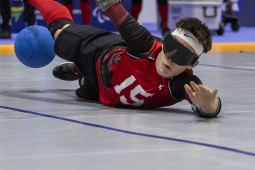
a young man, diving on the floor during a goalball game. Wearing a team Canada red and black jersey, a white headband, and black coloured blind fold. The ball is blue. / Un jeune homme plongeant au sol lors d'un match de goalball. Il porte un maillot rouge et noir de l'équipe du Canada, un bandeau blanc et un bandeau noir sur les yeux. Le ballon est bleu.
Goalball: A Life-Changing Sport Gateway for the Visually Impaired
[ Feature Article ] At fourteen, Harry Nickerson became the youngest-ever member of the Canadian Men's Goalball Team—not because the system found him, but because a chain of referrals happened to hold together. This article uses his journey to explore goalball's transformative potential for young people with vision loss and the role physical and health educators (PHE) can play in making sport access a reliable pathway rather than a fortunate accident.
Authored by: Harry Nickerson
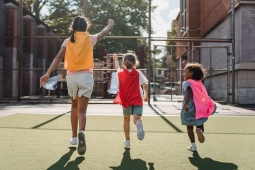
Three children in vibrant clothing joyfully running on a court, showcasing energy and playfulness. / Trois enfants en vêtements colorés courent joyeusement sur un terrain de jeu.
Walking is a Superpower!
[ Feature Article ] How can a simple walk be one of the most powerful choices we make? In this piece, eleven-year-old Ishaani Basu draws on research to explore how walking outside can improve physical and mental health, reduce harmful greenhouse gas emissions, and even free up government resources for people experiencing homelessness.
Authored by: Ishaani Basu
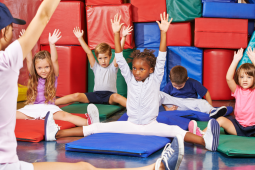
Children practicing various yoga poses in a gym class, demonstrating focus and balance. / Des enfants pratiquent des poses de yoga dans une salle de gym, concentrés et en harmonie avec leur environnement.
Who Plays, Who Doesn’t, and Why It Matters: The Case for Better Participation Data in Schools and Their Communities
[ Feature Article ] This article explores why high-quality, consistent, and useful sport and physical activity participation data matter for educators, schools, and communities. Although Canada has valuable national surveys and respected organizations that monitor participation, important gaps remain in understanding who participates, who does not, and where barriers to participation exist, particularly within school settings. Drawing on examples from Canada and abroad, the article examines how more coordinated and accessible participation data can support a range of actions that allow more children and youth to be active. It also highlights emerging initiatives that aim to provide decision-makers with more timely, integrated, and actionable sport and physical activity participation information.
Authored by: Jeffrey Gaudet, Dr. Sasha Gollish, Vanessa Coulbeck, Dr. Catherine Sabiston, Dr. Mathieu Bélanger
A group of children joyfully running down a brightly lit hallway, showcasing their excitement and energy. / Un groupe d'enfants court joyeusement dans un couloir, exprimant l'énergie et l'enthousiasme.
Active Bodies, Thriving Minds: Bridging the Physical Activity–Mental Health Gap in Schools
[ Feature Article ] How can we better connect the dots between movement and mindset in our schools? This article draws on research conducted in Ontario school boards and schools; however, the challenges and opportunities identified are relevant across Canada. While specific policies and programs may differ between provinces and territories, schools nationwide are grappling with many of the same questions around student mental health, physical activity, and how best to support young people to thrive amongst competing demands.
Authored by: Dr. Sasha Gollish, Sarah Ryan, Vanessa Coulbeck, Samira Sunderji, Dr. Catherine Sabiston
A group of people holding signs at a rally. One sign says "SAVE THE PLANET" with a blue drawing of the Earth. Another sign says "COOL KIDS SAVING HOT PLANET".
Examples of How a Comprehensive School Health Approach Can Be Used to Address Climate Change
[ Research ] Climate change represents a profound threat to the health and wellbeing of today's children and adolescents, yet its impacts on these populations are not fully understood. Evidence indicates that climate-related extreme events, and the stress associated with climate change, may significantly affect young people's mental health, educational attainment, and physical activity levels. Schools can play a pivotal role in addressing these challenges. One approach to addressing these challenges is using a Comprehensive School Health (CSH) model, which encompasses four pillars: teaching and learning, social and physical environment, healthy school policy, and partnerships and services. This paper presents illustrative ideas for programs, policies, or practices that could align with different pillars of the CSH model in relation to climate change. These examples are intended to prompt discussion and reflection, rather than to assert effectiveness, and may offer ways schools could consider supporting students in responding to climate-related concerns, including climate anxiety, and developing skills to navigate environmental challenges.
Authored by: Brenton Button, Will Burton, Gina Martin
Two children hold a red hoop between them with their hands, smiling.
Hula Hoops as Versatile Equipment for Target Games
[ Feature Article ] Hula hoops are incredibly versatile pieces of equipment. They can be used as stationary targets lying flat on the ground, rolling targets for chase or toss games, or even aerial targets when tossed into the air.
Authored by: Dr. John Byl